Dashboard: Dashboard · method: _RESEARCH-METHOD · market grid: _MARKET-PROBLEM-MAP · opportunity lens: _OPPORTUNITY-LENS · landscape: _LANDSCAPE-SYNTHESIS
Purpose: decide what Sablono is to us — a competitor for our claims/entitlement wedge, a data source to build on, or an acquisition. The brief first explains what Sablono is and how it works, then maps exactly where its product stops, and concludes on the one question that matters: does Sablono itself recover money from delay (area 15), or does it produce the time-stamped evidence a claim is built from and hand it on? Evidence (a low-volume 9-review Capterra sample, vendor product/API/pricing pages, four walkthrough videos) is at the end.
Snapshot
| What it is | A construction production / programme-tracking platform: it imports your master schedule (Primavera P6, Asta Powerproject, MS Project), breaks it into trackable activities per location, and records real-time actual-vs-plan progress captured on site by QR-code scan and mobile app |
| Core job it does | Replaces the spreadsheet progress tracker. Turns an imported schedule into a live, time-stamped “who did what, when” record of build progress and quality, visualised against the baseline |
| Who buys | General contractors, developers and main contractors on large, repetitive, complex projects (high-rise residential, fit-out, façade, infrastructure, solar); project-controls / planning / commercial functions. Berlin HQ; UK/EU-heavy with global flagship projects |
| Business model | Sales-led, quote-only; three packages (Track / Trace / Flow); 12-month minimum term; priced by project/activity volume, not published |
| Openness | A documented reporting API (BETA, token auth, JSON/CSV, daily batch) exposes progress, notes and commercial values by project; schedule round-trips via XER/XML/CSV file import-export and an Asta macro. Data can be pulled out; it is reporting-read, not real-time CRUD |
| Public ratings | No US App Store listing; UK App Store 4.67 (only 3 ratings); Capterra ~4.9 on a tiny, heavily solicited 9-review sample (treat as directional only) |
| Strongest areas | Progress/production tracking, scheduling/programme execution, quality QA |
| Weakest areas (our interest) | Change / variation / claims / entitlement recovery; cross-firm historical-cost benchmarking; estimating; accounting |
| Our verdict | Consume it as the delay-evidence data source for our claims layer. It is a partner, not a competitor — it builds the as-built record but does not build the claim |
Where Sablono plays across the market
Scored 0 (not addressed) to 100 (best-in-class) against the 21 areas in _MARKET-PROBLEM-MAP, sorted by coverage.
| Problem area | Coverage | Note |
|---|---|---|
| Progress / production tracking | 90 | The core: real-time actual-vs-plan on the imported baseline, QR-scan capture, planned-vs-actual dashboards |
| Scheduling / programme | 75 | Imports P6/Asta/MSP, explodes it into per-location activities, runs lean look-ahead and weekly work planning; exports progress back |
| Quality / QA-QC / snagging | 70 | QA checklists attached to activities, quality audit trail, photo defect capture, plot-by-plot sign-off |
| Communication / client collaboration | 45 | Cross-company / subcontractor coordination, automated trade-to-trade handover notifications, shareable reports |
| Field management / daily reporting | 35 | Mobile capture of status, issues, notes, photos — but scoped to activity progress, not a general daily log |
| Project management (system of record) | 30 | A controls layer on top of an existing schedule and SoR, not a Procore-style central record |
| O&M / handover | 25 | Digital trade-to-trade handover workflow; not an asset/manuals handover product |
| RFIs / submittals / document control | 20 | Issues/notes against activities; no RFI or submittal workflow |
| Equipment / asset / material | 15 | Component tracking on some projects (façade panels); not a fleet/material module |
| Cost management / forecasting | 15 | Commercial Dashboard links cost to activities; Commercial Look-Ahead forecasts upcoming cost — but it values work, it does not run job costing |
| Change / variations / claims / entitlement | 15 | Progress Audit Trail is sold to defend against claims and resolve disputes; it does not quantify a delay, build a claim or recover money |
| BIM / design coordination | 15 | Visual trackers can sit on drawings/plans; no model coordination |
| Time, labour and workforce | 10 | Tracks who completed an activity, not crew hours or productivity rates |
| Insurance and risk | 10 | The audit trail supports risk defence; no module |
| Safety and compliance | 5 | Not a focus |
| Reality capture / drone | 0 | Not addressed |
| Bid / tender management | 0 | Not addressed |
| Estimating / takeoff | 0 | Not addressed |
| Prequalification / procurement | 0 | Not addressed |
| Accounting / AP-AR / payroll | 0 | Not addressed |
| Historical cost / benchmarking | 5 | Per-project history exists; no cross-firm benchmarking product |
Takeaway: Sablono is narrow and deep. It concentrates in three adjacent areas — progress (90), scheduling execution (75) and quality (70) — and is the single best tool in the whole field at one specific thing: producing a time-stamped actual-vs-plan record on an imported P6/Asta/MSP schedule. That record is the literal evidence backbone of a delay or extension-of-time claim. But Sablono’s own product stops at producing and defending that record. Change/claims/entitlement recovery (15) and cross-firm historical cost (21) — the two columns central to our thesis — are exactly where it does not go. That is not a weakness to exploit by competing; it is the seam where its data feeds our product.
The input side — how work gets captured
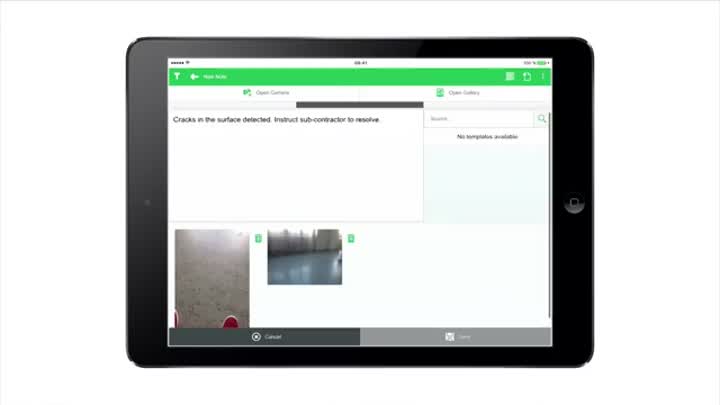
- Captured: activity status against the imported schedule (started / finished / confirmed / rejected / waiting), quality-checklist results, issues and “disruptions”, notes, photos — all stamped with who, what location, and when.
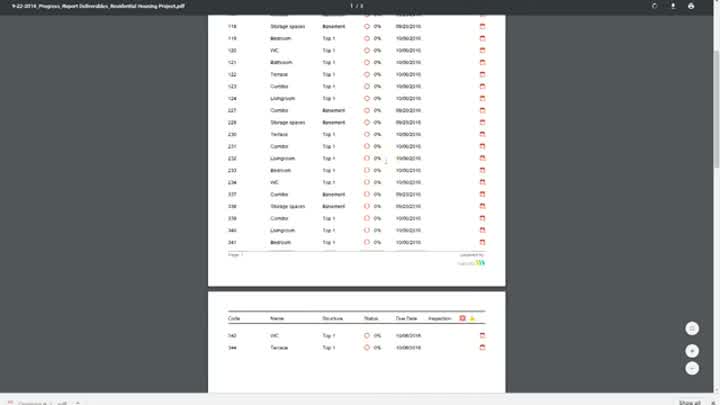
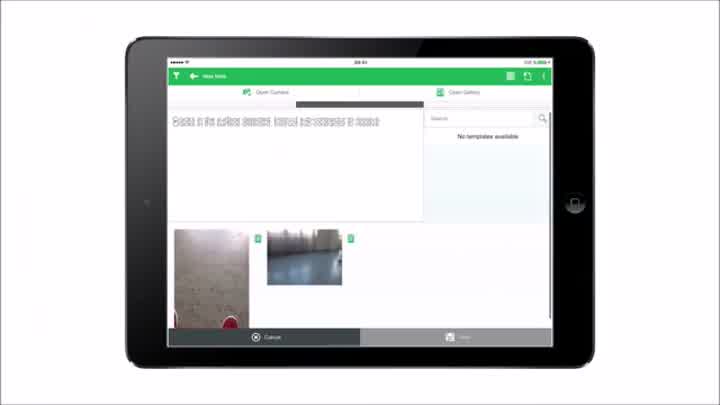
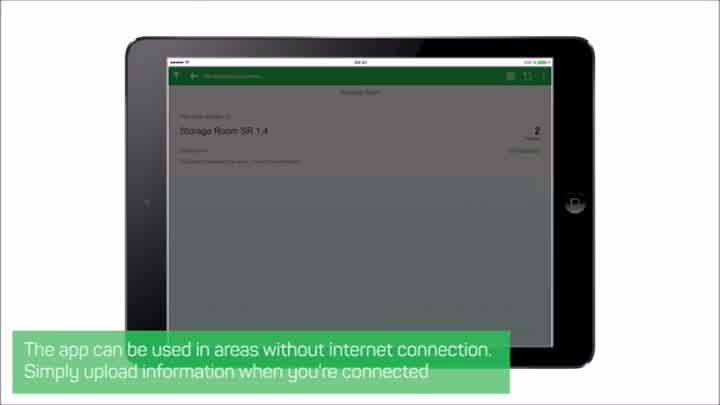
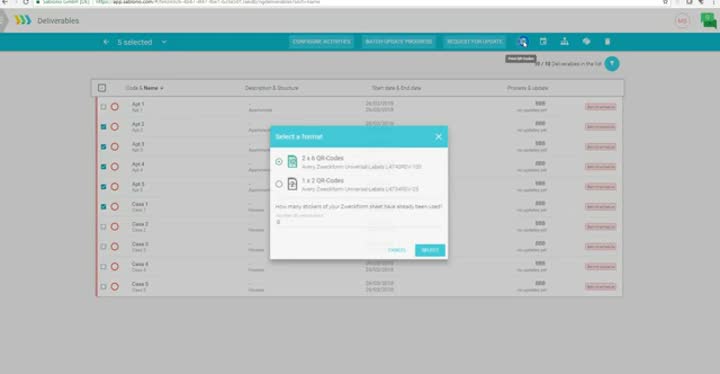
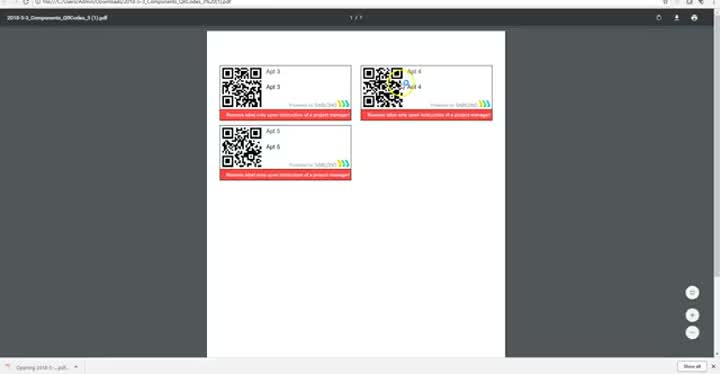
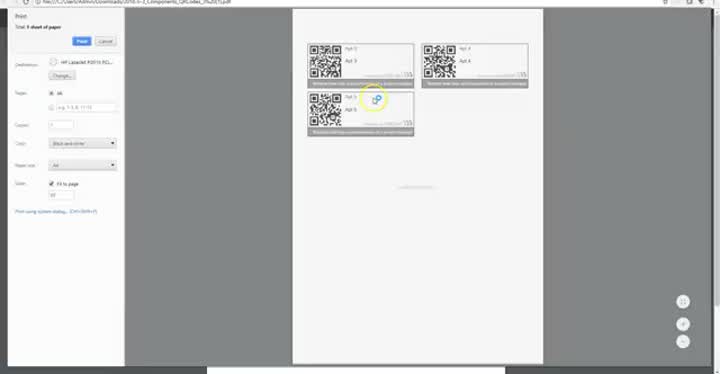
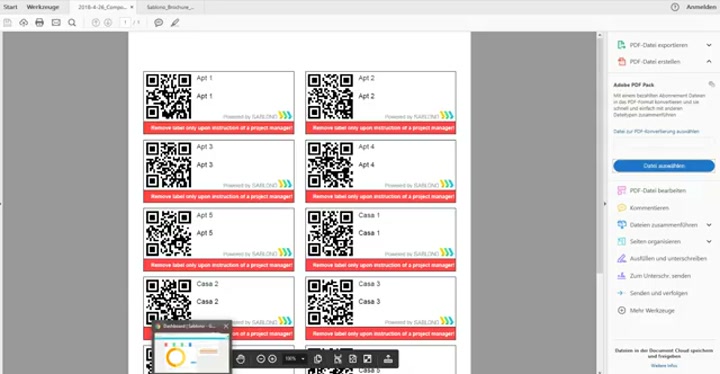
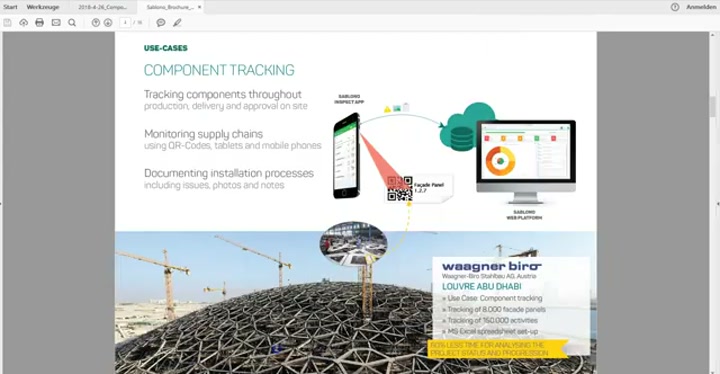
- Input methods: the signature mechanism is QR-code scanning — a printed QR label per room/apartment/component (“Powered by SABLONO”); a site engineer scans it and updates the activity from the mobile Inspect app. Also direct status update in the app and on the web tracker. Capture is structured against the schedule, not free-form.
- Onboarding / ease: the most-praised aspect in reviews — “users and administrators do not need training, it is straight forward”; non-technical site engineers update status by scanning a code. Project set-up (importing and templating the schedule) is the heavier lift.
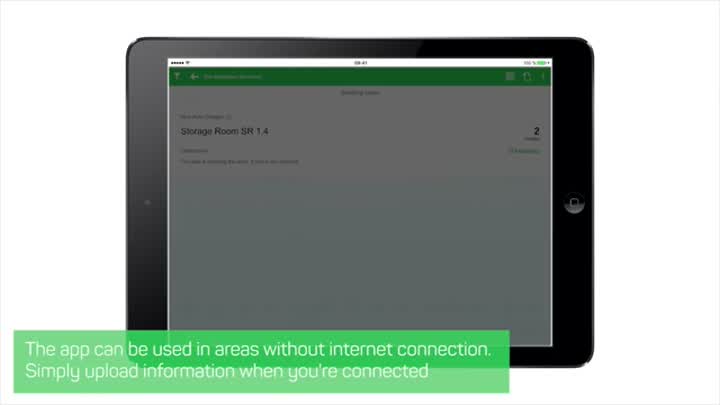
- Friction (from reviews): the structure that makes it powerful also makes it rigid — rigid floor/unit-based scheduling that “did not really work” for residential done per-floor not per-flat; difficulty changing programme base dates once set; “impossible to change progress” once recorded (by design, for the audit trail); occasional mobile signal loss; and a recurring ask for more third-party integrations.
The management side — what the office sees
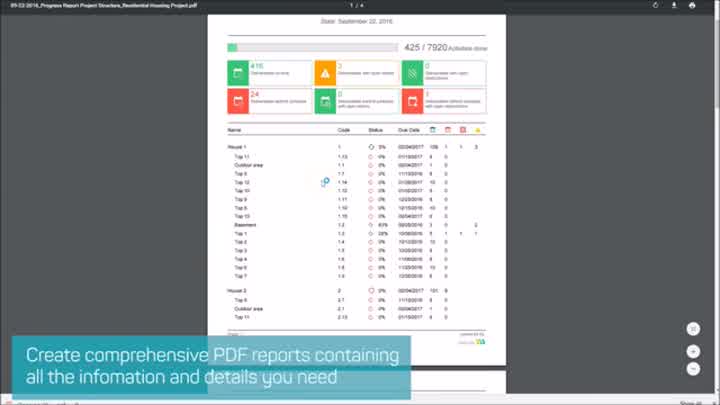
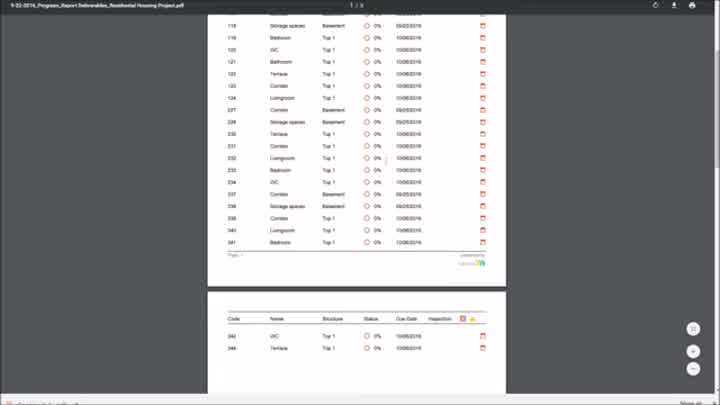
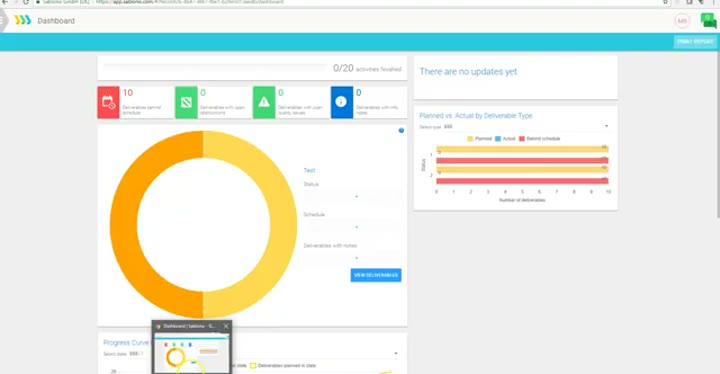
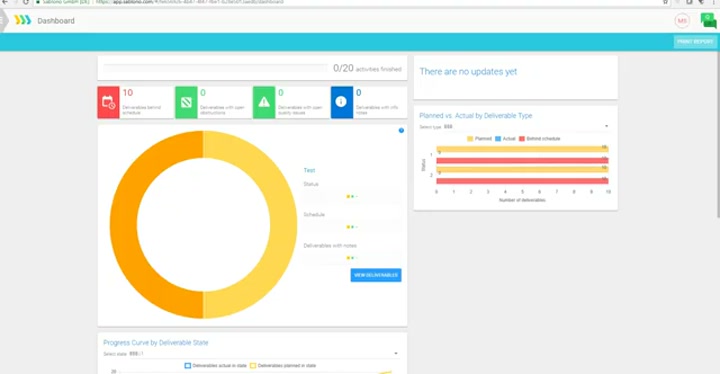
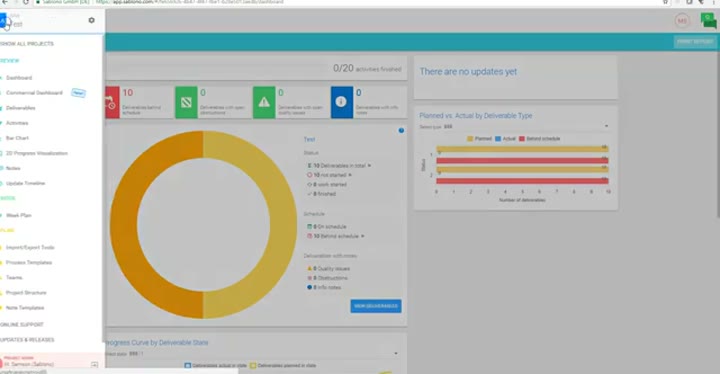
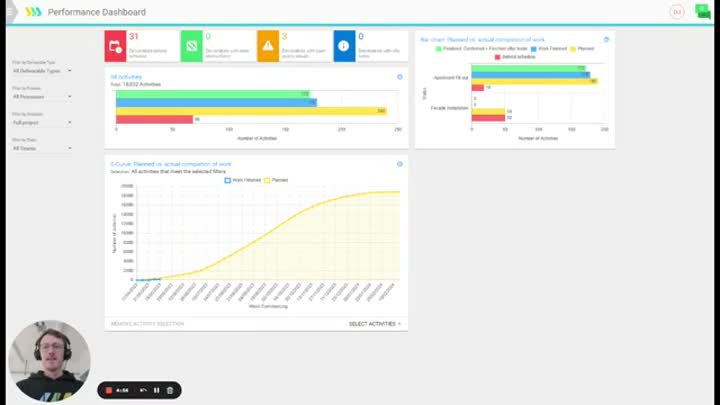
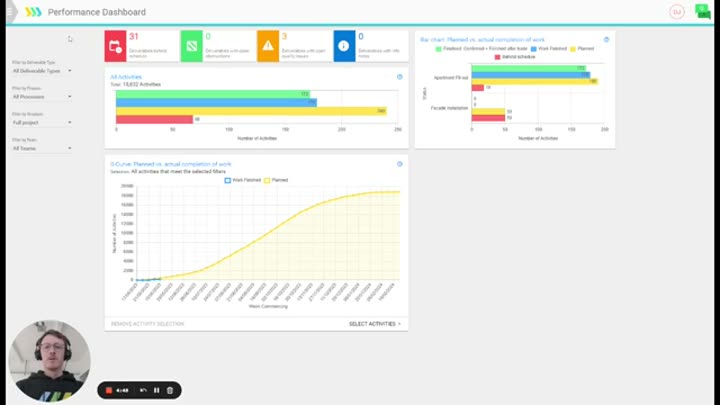
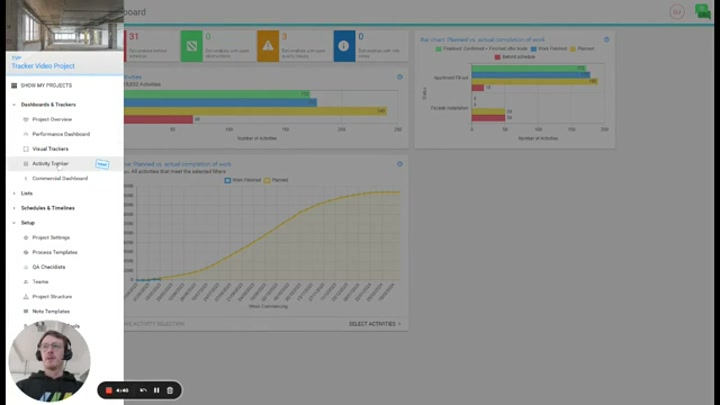
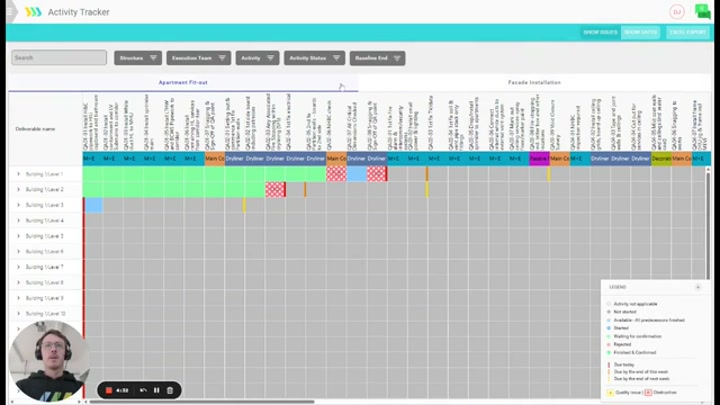
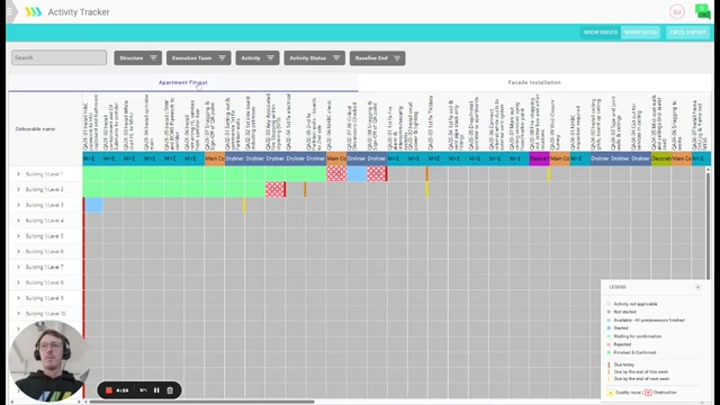
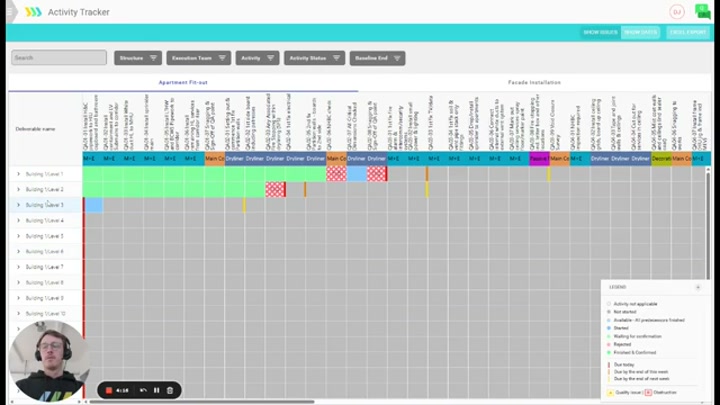
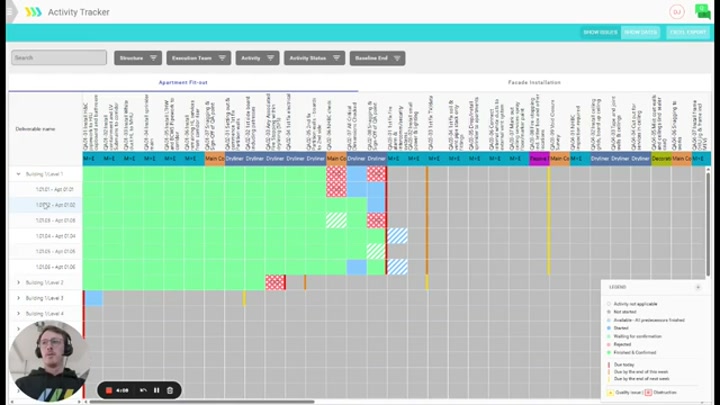
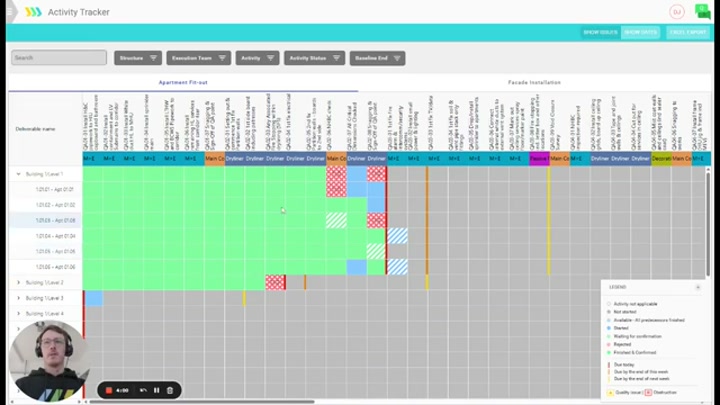
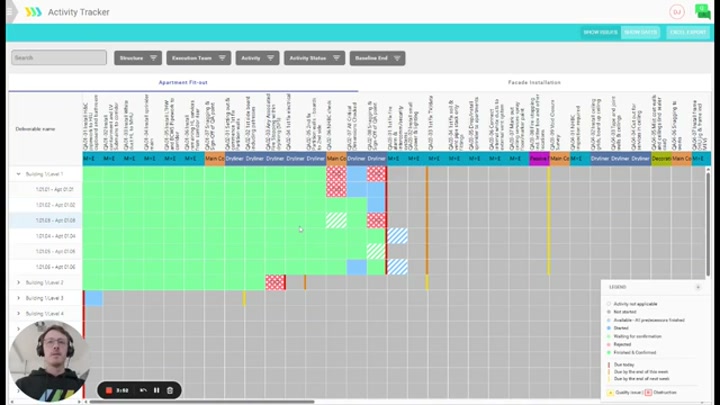
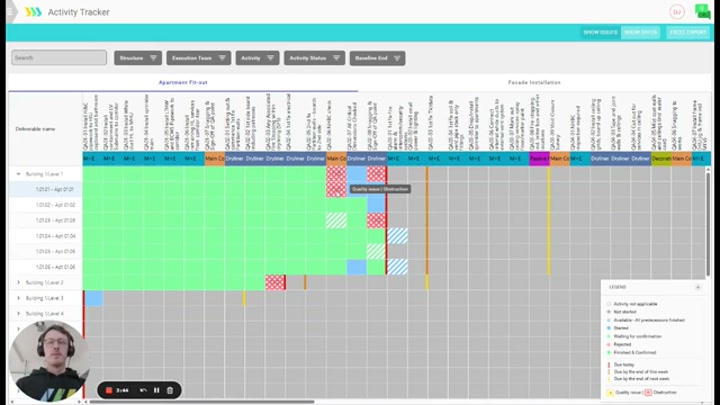
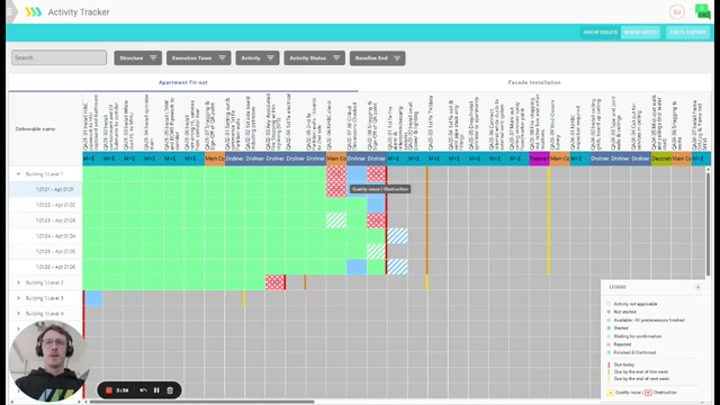
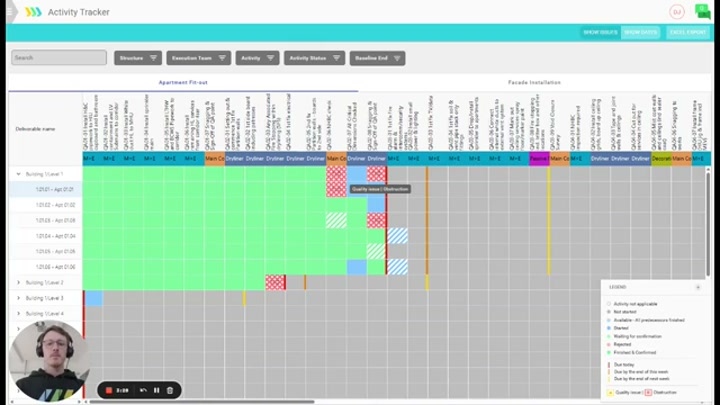
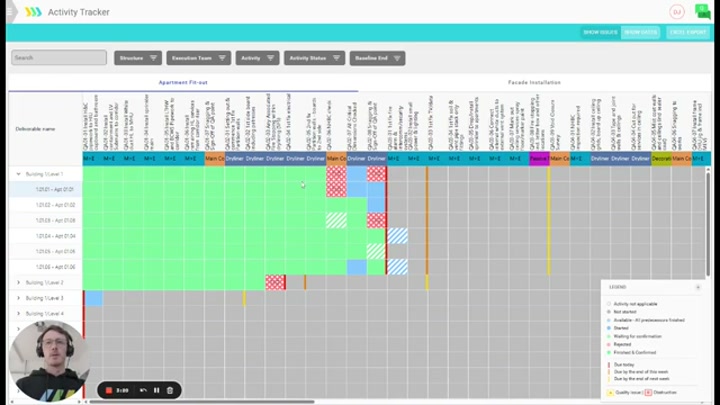
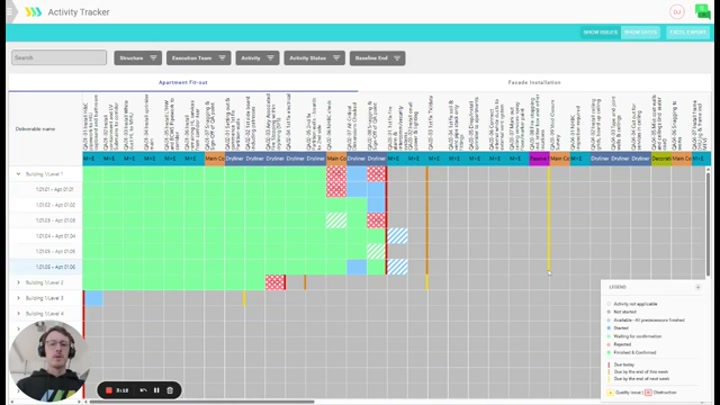
- Lands in the web dashboard: the Activity Tracker — a matrix of deliverables (rooms, apartments, façade panels) down the side against activities across the top, every cell colour-coded by status against a Baseline End column, with disruptions and quality issues flagged inline. Plus planned-vs-actual dashboards, KPI/delay detection, look-ahead plans, a Commercial Dashboard and a Progress Audit Trail.
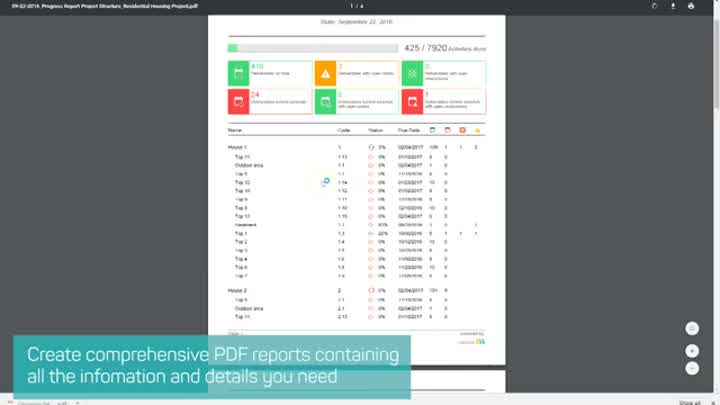
- Who consumes: project controls and planners (progress vs baseline), site/project managers (what is ready, what is blocked), the commercial team (valuing completed work to pay subcontractors), and senior stakeholders (one-glance project status without a site visit).
- Valued most: the live, granular, visual overview — “in one quick overview the progress… live, where we are at any specific moment” — and that the baseline programme updates automatically from site input.
- Pains: flexibility when site reality diverges from the templated structure; limited third-party connectivity; the deliberate immutability of recorded progress frustrates users who want to correct it.
- The structural boundary (evidenced): the dashboard is a production-and-quality controls view anchored to the schedule. Its commercial reach is valuation — pricing completed work to certify subcontractor payment — and its claims reach is defensive: the audit trail is pitched to “protect against claims” and “resolve disputes”, not to build or quantify one. There is no delay-analysis engine, no entitlement workflow, no claim-package assembly, and no cross-firm cost intelligence. Sablono shows how the work is going and proves it happened; it does not turn that proof into a recovered claim.
Where the value actually comes from
| Sales story (what wins the trial) | Real source of stickiness (what makes it hard to leave) |
|---|---|
| Real-time, visual actual-vs-plan progress that replaces the spreadsheet tracker on a complex project | The imported schedule is exploded into thousands of templated activities and months of time-stamped as-built history accumulate against it — re-creating that record and re-training the trades elsewhere is painful mid-project |
| QR-scan capture any site engineer can do without training | The accumulating audit trail becomes the project’s authoritative “what happened when” — the more it holds, the more it is the source of truth |
- Do not attack: the actual-vs-plan tracking loop, the QR capture mechanism, the schedule-import-and-explode engine, the quality audit trail — this is Sablono’s deep, defended ground and the part we want to consume, not rebuild.
- Where value stops: Sablono converts a schedule plus site input into a proven progress-and-quality record, and values completed work for payment. It does not convert that record into a quantified, recovered delay/disruption claim, and it holds no cross-firm cost history. That boundary is precisely our wedge — and Sablono’s record is the best input to it.
What users say — both sides
Credibility first: this is a very small sample. Only 9 Capterra reviews exist, and 8 of 9 (89%) are vendor-solicited (one incentivised), with just 1 organic — so the ~4.9 average and the all-5★ histogram are directional at best, not a reliable rating. The reviews are multilingual (English, Spanish, German) confirming the UK/EU/LatAm spread. Sub-ratings cluster high (ease 4.44, features 4.44, value 4.43, support 5.0) but on a base too thin to weigh. There is no US App Store presence and only 3 UK App Store ratings. Treat all numbers below as colour, not measurement.
| Praised | Criticised |
|---|---|
| Live, granular, visual progress (“one quick overview… where we are at any moment”) | Rigid structure — floor/unit scheduling that fails when work is organised differently (per-floor not per-flat) |
| No training needed; any site engineer can scan and update | Cannot change programme base dates / cannot change recorded progress (immutable by design, but frustrating) |
| QR-code capture; auto-updates the baseline programme | Limited third-party connectivity; “needs more integrations" |
| "Easier and more transparent valuations”; plot-by-plot client reports | Mobile signal loss on site; everyone needs a recent device + data plan |
| Manages time, cost and quality together on complex projects | Set-up/implementation effort; less flexible for refurbishment workflows |
- Representative positive (site engineer / main contractor): QR-scan status updates per room, 2D-plan visualisation of progress, and the baseline programme auto-updating from site input — “this helped the project a lot.”
- Signal for us: one reviewer’s praise for “easier and more transparent valuations” is the tell — users already pull Sablono’s progress data toward commercial/payment use. That is the QS-adjacent buyer we target, and the data is one step short of a claim. Sablono takes them to the valuation; nobody takes them to the recovered claim.
The opportunity for AI in this space
- AI does not help Sablono’s core, and is not where our value is either. The core is structured capture (QR scan → status) against a templated schedule, plus deterministic roll-ups (planned vs actual, look-ahead). That is data plumbing and visualisation, not language-model-shaped work; an LLM does not reimagine it.
- AI takes over the layer Sablono explicitly declines. Sablono produces the time-stamped as-built record and stops, pitching it defensively (“protect against claims”, “resolve disputes”). The unbuilt, document-and-judgement-heavy work sits on top: take that actual-vs-plan record, identify the critical-path delay events, attribute cause, draft the delay/disruption narrative, and assemble the entitlement/EOT claim package. That is generative, adversarial, P&L-bearing work cheap models now do well — and the barrier was never inference cost, it is data access and judgement. Sablono already holds the data and exposes it on an API.
What we would build:
- Baseline to match: nothing on Sablono’s turf — we do not rebuild progress tracking or QR capture. We ingest.
- Recurring pains we can solve: turn the immutable audit trail (a frustration for users wanting to correct it, but the perfect evidentiary asset) into a forward artefact — the structured delay/disruption claim — rather than only a backward defence.
- Niche to target first: the commercial / QS / project-controls office on UK-EU complex projects — Sablono’s own buyer and geography — who today export progress into spreadsheets to argue an extension of time by hand.
How open the platform is
- API / integrations: a documented reporting API (labelled BETA) at
developers.sablono.link, token-authenticated, returning JSON/CSV, with endpoints including progress, notes and — notably — Commercial Values by project ID; files refresh daily, which is how the official Power BI dashboard pulls Sablono data. Schedule data round-trips with P6/Asta/MSP via XER/XML/CSV import-export plus a “Sablono Macro” for merging progress back into an Asta schedule. - What it means: the actual-vs-plan record — including commercial values — can be pulled out programmatically, which is what our build-alongside thesis needs. It is reporting-grade (read-oriented, daily batch), not a real-time two-way CRUD API, so we would ingest a daily as-built feed rather than write back. That is sufficient: we want to read Sablono’s evidence, not control its workflow. The same openness is available to anyone, so it is no moat for Sablono — and on balance it favours us, because sitting on Sablono’s feed to build the claim is far easier than Sablono building the claims product itself.
Sablono’s own AI — claims, shipping, and how far they can go
Sablono shows no shipped, beta, or even announced AI of substance. This is the rare case where the talk-vs-ship gap is narrow because there is little talk — the product is positioned on real-time data and lean execution, not intelligence.
| Feature | What it does | Status |
|---|---|---|
| Automated KPIs / delay detection | Threshold-based flags on progress vs baseline (deterministic, not ML) | Shipped |
| Look-ahead generation | Rolls granular progress into upcoming-work plans (rules, not ML) | Shipped |
| (Any LLM/AI feature) | Not found on product, blog, newsroom, or pricing pages | None verified |
- Nothing in the product is language-model-shaped; what looks like “intelligence” is deterministic roll-up and dashboarding. No generative drafting, no claim assembly, no predictive cost.
- Confidence Sablono ships a real claims/entitlement-recovery AI within ~2 years: low (about 1 in 5). Reasons: it is a different product (adversarial document generation and quantification, not progress capture) for a partly different buyer (claims consultants / commercial leads, beyond their planning-controls champion); their roadmap and identity are anchored in lean production tracking; and they have shown no AI muscle to redeploy. The more likely move, if any, is exposing more of the audit trail via API — which helps us. Main risk to this read: a claims-tech firm or a platform acquires Sablono specifically for its as-built dataset.
Who actually uses Sablono
Segmentation is from the 9-review Capterra sample — too small to generalise; read as anecdote, corroborated by the vendor’s published case studies (e.g. Louvre Abu Dhabi façade: 8,000 panels, 160,000 activities tracked).
| Company size (9-review sample) | Share | Note |
|---|---|---|
| 11-50 employees | 11% | 1 review |
| 51-200 employees | 44% | 4 reviews |
| 501-1,000 employees | 22% | 2 reviews |
| 10,001+ employees | 22% | 2 reviews |
- Skew to mid-size and enterprise contractors on large, complex, repetitive projects — high-rise residential and fit-out, façade, infrastructure, solar. The presence of two 10,000+-employee firms fits a flagship-project, enterprise sales motion.
- Role: office/controls (planners, project/commercial managers) consume centrally; site engineers are the capture endpoint. The paying decision sits with project controls / commercial, not the field.
- Industry: construction and civil engineering, one real-estate developer; multilingual reviews (EN/ES/DE) confirm UK/EU/LatAm reach.
- Alternatives considered / switched from (sample): one reviewer considered Viewpoint Field View; one switched from Microsoft Excel — i.e. Sablono typically displaces the spreadsheet tracker and the planner’s manual progress mark-up, not another production-tracking product.
Our read — can we enter and win?
Sablono is not a competitor to enter against — it is the supply side of our wedge, and the most thesis-relevant one in the whole field. It produces the single best raw material a delay or extension-of-time claim needs: a time-stamped, granular, defensible actual-vs-plan record on the contractor’s own imported P6/Asta/MSP schedule, sold to the very commercial/project-controls buyer we target, in our UK-EU geography. And it stops exactly at the doorway to area 15 — its claims posture is defensive (an audit trail to “protect against claims”), never recovery (quantify the delay, attribute cause, assemble the entitlement, recover the money). Because its reporting API exposes that record — commercial values included — we should build alongside it: ingest the daily as-built feed and own the claims layer Sablono declines to build. The way in is the QS/commercial office that already exports Sablono progress into spreadsheets to argue an EOT by hand; the expansion path is the same firms’ next projects and, over time, the cross-firm historical-cost loop neither Sablono nor anyone else holds. The one thing that would make us reconsider is a platform or claims-tech firm acquiring Sablono for its as-built dataset and bolting a recovery engine on top before our data loop exists — possible, but it would still require building the different, adversarial product Sablono has shown no appetite or muscle for.
| Question | Our read |
|---|---|
| Where is Sablono strong and off-limits? | Actual-vs-plan progress tracking, QR capture, schedule-import-and-explode, the quality audit trail — deep, defended, and the part we consume rather than rebuild |
| Where is the verified gap? | Claims/entitlement recovery (quantify delay, attribute cause, assemble the EOT/disruption claim, recover money) and cross-firm historical-cost benchmarking — its product stops at producing and defending the record |
| How hard for Sablono to follow us? | Hard. Recovery is a different, adversarial product for a partly different buyer; they have no AI muscle and their identity is lean production tracking. More likely they open more data than build the claim |
| How much can cheap AI do here? | A great deal — delay narrative, cause attribution and claim-package assembly are generative, document-heavy work; Sablono already holds and exposes the structured input |
| Is there a cheap, narrow way in that grows? | Yes — ingest Sablono’s daily as-built feed via its reporting API and draft the claim for the QS office, expanding into the cross-firm cost loop |
| What would make us walk away? | A platform/claims-tech acquirer buying Sablono for its dataset and shipping a real recovery engine on it before our data loop locks in |
| Overall | Partner / consume as data. Build the claims-recovery layer on top of Sablono’s evidence; do not compete with the tracker |
The app itself — ratings and reception
| Store | Rating | Ratings count | Note |
|---|---|---|---|
| App Store (US) | — | 0 | No meaningful US listing / 0 ratings |
| App Store (UK) | 4.67 | 3 | Companion capture app; tiny base |
| Capterra | ~4.9 | 9 | 89% vendor-solicited; directional only |
The mobile app is a companion capture endpoint (scan QR, update status), not the product — the product is the web platform the office consumes. The negligible store footprint reflects that, and an enterprise, sales-led, project-controls motion rather than self-serve mobile reach. Reach is via flagship projects and EU contractors, not app-store volume.
Screenshots
Grouped by theme, full-size, scrollable. Images render in Obsidian and exported HTML through embeds (referenced, not copied). Full set and gathering method: screens/README. No App Store hi-res set exists — the listing carries 0 screenshots — so the visuals are walkthrough-video frames; one whole-set contact sheet is linked at the end. Frame filenames cited are under screens/video_frames/.
The core — the Activity Tracker (actual-vs-plan on the imported schedule)
The heart of the product, and the literal evidence backbone of a delay claim: deliverables (apartments, façade panels) down the side, activities across the top, every cell colour-coded by status against a Baseline End column. Disruptions and quality issues are flagged inline (note the “Quality issue / Disruption” tooltip), with a legend for not-started / started / waiting / rejected / finished-and-confirmed and due-today / this-week / next-week.
Capture — the QR-code mechanism
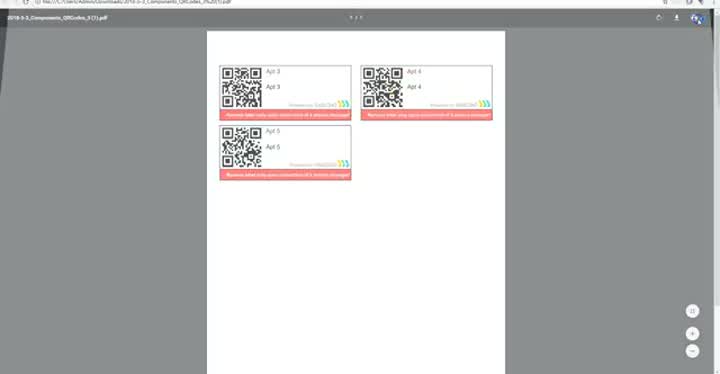
Printed QR labels, one per apartment/room/component (“Powered by SABLONO”); a site engineer scans and updates the activity from the mobile Inspect app. The marketing slide shows the whole loop — Inspect app → QR scan on a façade panel → web platform — and the Louvre Abu Dhabi case study (8,000 panels, 160,000 activities).
Quality — defect evidence
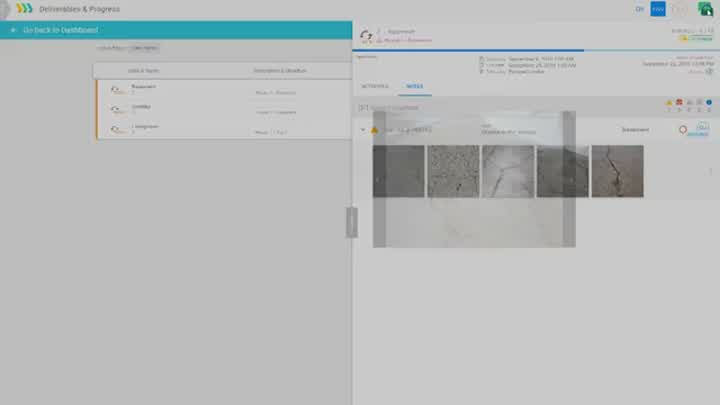
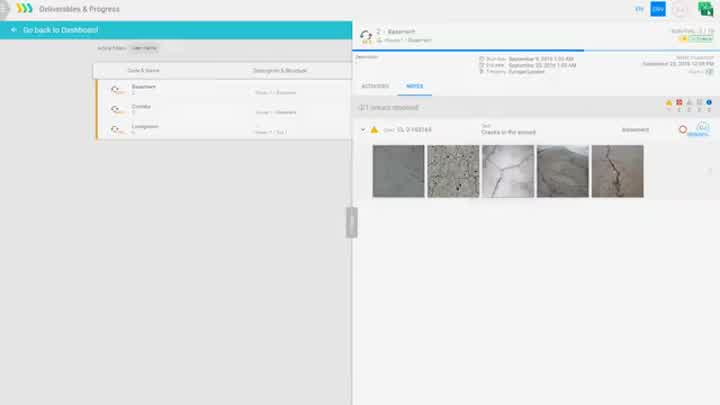
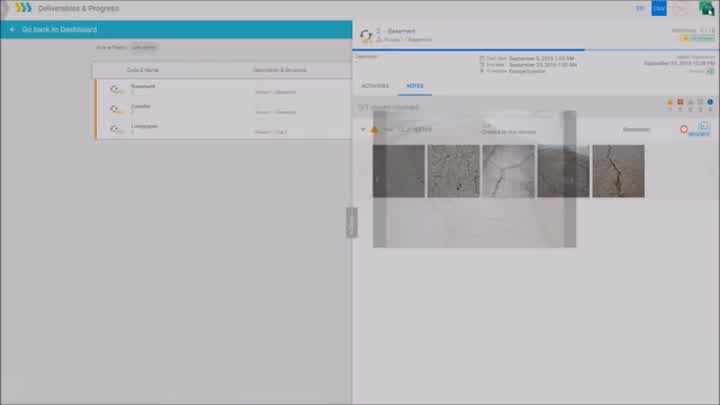
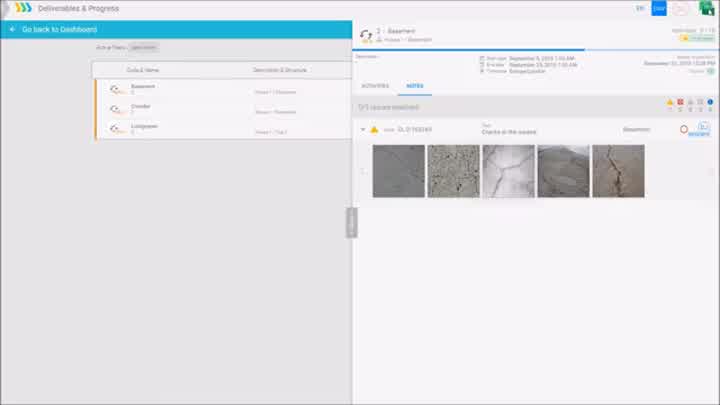
Quality checklists attach to activities; defects (here, concrete cracking) are photographed and time-stamped into the audit trail — the same record pitched to defend against claims.
In the field
The product in use on a live, complex residential/fit-out site — the kind of repetitive, multi-unit project Sablono targets.
Whole-set contact sheet
For a single-glance overview of every captured frame: contact_video.jpg (all walkthrough-video frames across the progress / lean / tracker / QR videos). No App Store contact sheet — the listing has no screenshots.
Sources and method
- Product / platform / dashboards / commercial valuation / lean look-ahead: vendor site corroborated by search —
raw/exa_search.json,raw/exa_answer.json, plus WebFetch of sablono.com platform, pricing, intelligence-and-reporting, progress-audit-trail and integrations pages (the claims boundary verified directly on the Progress Audit Trail page: it provides the evidence record and is pitched to defend against claims, with no delay quantification, EOT computation, or claim-package assembly). - Openness / API: the Sablono Help Center Power BI article +
developers.sablono.link(reporting API, BETA, token auth, JSON/CSV daily, Commercial Values endpoint) and the integrations blog (XER/XML/CSV file round-trip + Asta macro). - Pricing / packages: vendor pricing page (Track / Trace / Flow; 12-month minimum) + exa pricing colour ($500/mo small to $30,000+ enterprise, project-dependent — third-party estimate, not vendor-published).
- AI: searched product, blog, newsroom and pricing — no shipped/beta/announced LLM AI found; “intelligence” is deterministic KPI roll-up.
- Reviews (real segmentation, low volume): 9-review Capterra DOM/RSC scrape —
raw/capterra_dom_corpus.json, rolled up inraw/SUMMARY_DOM.md(89% solicited; treat as directional). App Store ratings:raw/appstore_app_us.json(0),raw/appstore_app_gb.json(4.67/3). - Visuals: four walkthrough videos (progress / lean / tracker / QR) →
screens/video_frames/; no App Store hi-res screenshots exist for this listing. Method: screens/README. - Method, limits, and the discipline of not asserting an absence without evidence: _RESEARCH-METHOD.