Dashboard: Dashboard · method: _RESEARCH-METHOD · market grid: _MARKET-PROBLEM-MAP · opportunity lens: _OPPORTUNITY-LENS · landscape: competitor-landscape-report
Purpose: decide whether Document Crunch occupies the part of the market we want — recovering money from changes, delays and claims — or a different, adjacent part. The brief first explains what the company is and how its AI works, then maps exactly where its job stops, and finally judges whether it is a competitor for our wedge, an upstream neighbour to build alongside, or a validation of our thesis. Because Document Crunch is a young AI-native vendor with no Capterra footprint and no real mobile app, the evidence here is mostly vendor-published case studies, funding and acquisition press, third-party AI-tool aggregators, and four marketing/testimonial videos — read with that caveat.
Snapshot
| What it is | AI risk-reduction platform purpose-built for construction; reads contracts, subcontracts and specs and turns them into plain-language risk flags, checklists, playbooks and chat answers |
| Core job it does | Catches contractual risk before signing and keeps teams compliant during execution (never miss a notice, obligation or deadline) — framed as preventing disputes, not recovering money from them |
| Who buys | General and specialty contractors, owners, insurers; usage has shifted from legal/risk teams to pre-construction, project and operations teams |
| Business model | Sales-led, quote-only; ~$200/month for small teams, volume-based enterprise; requires a separate subscription; no published free trial |
| Openness | Microsoft Word add-in and a Procore integration (notices to the field); no public developer API verified yet |
| Funding / ownership | ~$37M raised (Series A $9M Feb-2024, Series B $21.5M Oct-2024); being acquired by Trimble — announced 2 Apr 2026, expected to close Q2 2026 — folding into Trimble Construction One |
| Scale | 10,000+ projects; 17 document types; SOC 2 Type II |
| Strongest areas | Insurance and contractual risk; document control (RFIs, submittals, notices) |
| Weakest areas (our interest) | Change/variation/claims recovery (it prevents, it does not pursue); cost forecasting; field/ops capture |
| Our verdict | An upstream neighbour on the same documents we care about, not a competitor for the recovery wedge — but Trimble ownership turns the bundling risk from low to real |
Document Crunch was founded around 2019 in the Atlanta area by Josh Levy, a former construction attorney at contractors JE Dunn and Wood, and Trent Miskelly, a technical co-founder. The founding insight is narrow and sharp: the most expensive risk a contractor carries is buried in the contract and specifications it signs, and reading that risk out by hand is slow, inconsistent and lawyer-gated. Document Crunch applies a construction-trained language model to that one job. Over seven years it has processed contracts across thousands of projects and, in April 2026, agreed to be acquired by Trimble — which materially changes how we should think about it.
Where Document Crunch plays across the market
Scored 0 (not addressed) to 100 (best-in-class) against the 21 areas in _MARKET-PROBLEM-MAP, sorted by coverage. This is a deliberately narrow product, so most field, schedule and finance rows are near zero by design.
| Problem area | Coverage | Note |
|---|---|---|
| Insurance and risk | 80 | The core. Contractual and insurance-clause risk, flagged and cited |
| RFIs / submittals / document control | 60 | Generates submittal logs from specs; Project Assist drafts RFIs and notices |
| Change / variations / claims / entitlement | 35 | Reviews change-order documents for shifted risk and drafts notices — prevention, not recovery |
| Cost management / forecasting | 30 | Catches invoice/payment-mismatches and payment-term risk; no job costing or forecast |
| Communication / client collaboration | 30 | Routes risk to the right role; shares one read of the contract across the team |
| Safety and compliance | 25 | Contractual and regulatory compliance, not site safety |
| Bid / tender management | 25 | Spec review “spot risk before you price” touches the bid decision |
| Historical cost / benchmarking | 25 | Benchmarking infrastructure across contracts — for clause norms, not cost |
| Project management (system of record) | 20 | A project-risk hub, not a system of record |
| Prequalification / procurement | 15 | Reviews subcontracts and vendor agreements for risk |
| Quality / QA-QC / snagging | 10 | Spec review flags QA/QC and startup requirements |
| Estimating / takeoff | 10 | Spec clarity informs the estimate; no takeoff |
| O&M / handover | 10 | Some closeout-document review |
| Scheduling / programme | 5 | Flags schedule-impact and liquidated-damages clauses; no programme |
| Progress / production tracking | 5 | Not addressed |
| Accounting / AP-AR / payroll | 5 | Not addressed |
| Field management / daily reporting | 0 | Not addressed |
| Time, labour and workforce | 0 | Not addressed |
| BIM / design coordination | 0 | Not addressed |
| Reality capture / drone | 0 | Not addressed |
| Equipment / asset / material | 0 | Not addressed |
Takeaway: Document Crunch is concentrated in exactly four areas — insurance/risk, document control, contract-risk review, and the prevention edge of change/claims. It sits on the same documents our thesis cares about (contracts, change orders, notices) but does a different job with them: it reads risk into the team’s awareness so disputes never happen, rather than building the evidence to recover money once they do. The 35 on change/claims is the number to watch, and the rest of this brief is about what that 35 contains and what it does not.
The input side — how work gets captured
- Captured: the documents themselves, uploaded by the user — prime contracts, subcontracts, specifications, addenda, insurance policies, submittals, RFIs. Seventeen document types in all.
- Input methods: document upload to the web app; a Microsoft Word add-in that brings the analysis into the document the lawyer or PM is already editing; and a Procore integration that pulls contract context into the project environment teams already work in.
- How the AI reads it (vendor’s account): CrunchAI reads the whole document in sequence rather than sampling it, understands construction-specific structure (tables, cross-references, flow-downs) and terminology (it knows “LDs” means liquidated damages), connects risk across related documents, and cites every answer to a page number and highlighted clause. The vendor stresses it checks findings against the source before answering to suppress hallucination.
- Friction (from third-party reviews): it only works on documents you upload; it is English-only; it performs best on text-based .docx files and struggles with scanned or image-based PDFs; and it is explicitly not a substitute for legal counsel on complex disputes.
The management side — what the office sees
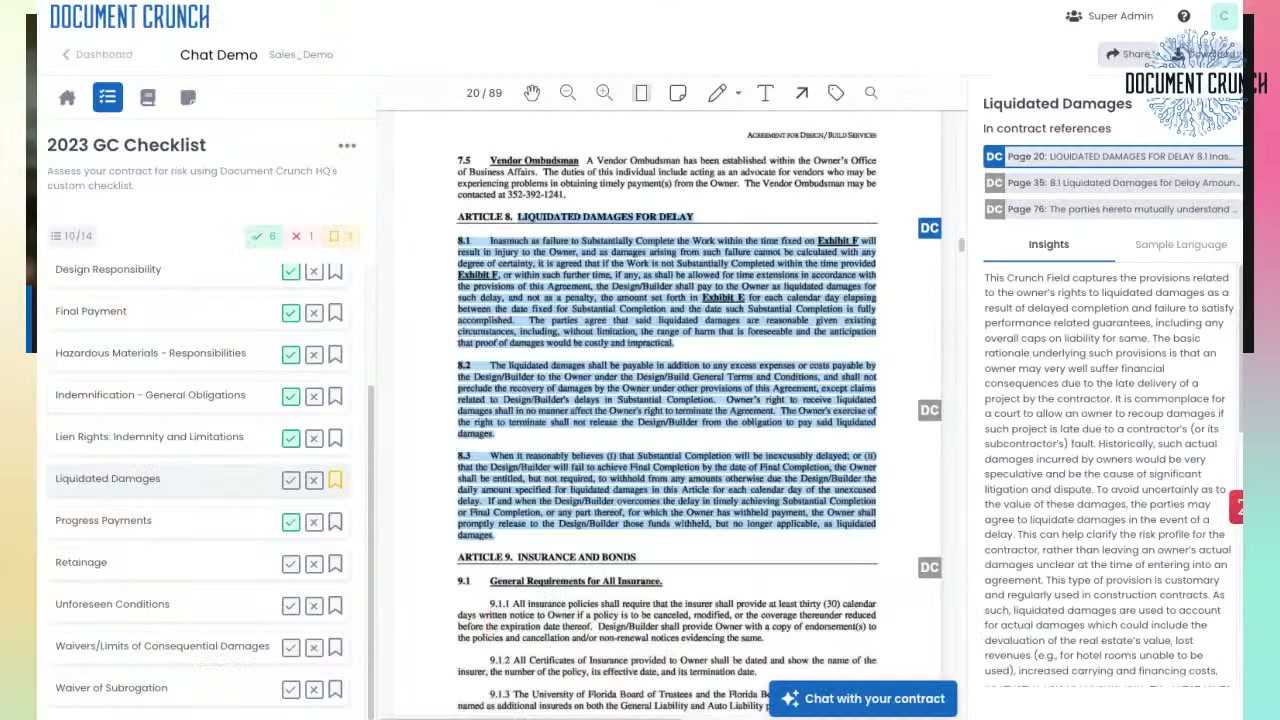
- Lands in the platform: a clause-by-clause risk read of each document — a “GC Checklist” listing items such as design responsibility, final payment, hazardous materials, indemnification, lien rights, liquidated damages, progress payments and waiver of subrogation, each marked pass / flag / watch. Alongside it sits the source contract with the relevant clause highlighted, and a plain-English “Insights” panel explaining what the clause means and why it matters, with a “Sample Language” alternative.
- Who consumes: originally legal and risk managers; today, per the founder, over 90% of usage is pre-construction, project teams, project controls and operations. The product deliberately moved from the lawyer’s desk to the project team’s daily work.
- Valued most: turning a multi-day manual review into minutes, and making contract obligations legible to people who are not lawyers but have to act on them.
- The execution layer: the Procore integration and the new Project Assist agentic layer (launched 9 June 2026) carry the product past signing — surfacing obligations, generating timely notices so deadlines are not missed, and drafting redlines, submittals and RFIs across the full project document set. The stated goal is “Zero Disputes.”
- The structural boundary (evidenced): every output is oriented to prevention and compliance. It tells you what risk you are taking on and reminds you to meet your obligations so a dispute never starts. It does not assemble the cost, time and causation record needed to recover money once a change or delay has happened. That boundary is the whole question for us, and it is examined directly below.
Where the value actually comes from
| Sales story (what wins the trial) | Real source of stickiness (what makes it hard to leave) |
|---|---|
| Read a 50-page subcontract in minutes; catch the indemnification or pay-if-paid clause that would have cost you; understand the contract without a lawyer | A construction-trained model plus seven years of processed contracts and a benchmarking corpus; an accountable, cited audit trail of who flagged what; embedding into Word and Procore where the work already happens; and now Trimble’s distribution |
- Do not attack: the contract-risk read itself. It is the company’s core, it is genuinely construction-specific, the buyer (legal/risk plus project teams) trusts it, and the moat is the accumulated data and the accountability trail, not the UI. Trying to out-read Document Crunch on indemnification clauses is the wrong fight.
- Where value stops: at prevention. Document Crunch converts a contract into awareness and compliance. It does not convert a project’s events — the change, the delay, the disruption, the differing site condition — into a quantified, substantiated claim that recovers money. The notice it drafts is the first step a claim needs, but the platform stops there; it does not build the entitlement, the quantum, or the narrative. That gap is our interest.
What users say — both sides
Credibility first: Document Crunch is an early-stage vendor with very little independent review volume. There is no Capterra corpus and no real mobile app to rate. What exists is a G2 product page (rating and count not retrievable — the page blocked scraping), a scatter of AI-tool aggregator entries with tiny or self-generated scores (one lists 3.8 from 27 reviews, another a self-scored 4.75), vendor case studies, and trade-press coverage of funding and the Trimble deal. Treat all of it as directional, not statistical. The strongest signal is not a star rating; it is the $37M raised, the strategic investors (Nemetschek, then Trimble as acquirer), and the 10,000-project claim — the market is validating the contract-review job even if the public review trail is thin.
| Praised | Criticised |
|---|---|
| Construction-specific training flags clauses generic legal AI misses (indemnification, pay-if-paid, LDs, retainage) | Requires document upload; English-only; weak on scanned/image PDFs |
| Up to 80% reduction in review time; playbook creation from days to minutes | Not a replacement for legal counsel on complex disputes |
| Plain-English summaries that non-lawyers can act on | Not a full contract-lifecycle suite (no intake, clause library, e-sign, renewals) |
| Cited answers (page number, highlighted clause) build trust | Proprietary models may lag frontier general LLMs |
| Generative checklists plus chat seen as a strong combination | Integrations beyond Word and Procore are thin |
- Signal for us: the praise is all on the read (understanding what you signed). None of it is about recovering money after the fact, because the product does not do that. The criticism that it is “not a full lifecycle suite” and that integrations are thin both point to a product that is deep on one slice and reliant on a partner ecosystem — which is exactly why Trimble bought it.
The opportunity for AI in this space
- AI is the product here, and it is real. Unlike a field-reporting incumbent where AI is polish, Document Crunch’s entire value is an LLM-shaped job: reading dense legal-technical documents and generating risk reads, summaries and notices. This is squarely the kind of work cheap models now do well, which is precisely why the company spent early 2026 defending itself against a free competitor (more on that below).
- But the adjacent job — recovery — is even more AI-shaped and is left open. Building a change or delay claim is document-heavy and generative: stitch the contract’s notice and change clauses to the daily logs, RFIs, programme slippage and cost record, then draft the entitlement argument and the quantum. Document Crunch holds the contract-side of that chain and even drafts the opening notice, but it does not assemble the project-event side or the money. That is a generative, agent-plus-SOP workflow with a compounding data loop (claim outcomes, entitlement benchmarks) — and it is unoccupied here.
What we would build:
- Baseline to respect: we do not need to re-read contracts as well as Document Crunch; we need to read them well enough to know which clauses govern entitlement (notice, change, delay, force majeure, differing conditions) and then go where it does not.
- The job to own: turning project events into recovered money — taking the contract’s entitlement clauses plus the field record and building the substantiated change/delay/disruption claim, with the quantum and the narrative.
- Niche to target first: the post-award commercial/entitlement layer for contractors who are exposed to disputes (the Arcadis 2025 report puts the average construction dispute at $60.1M, up 40% year on year, with errors and omissions in contract documents the leading cause three years running). Document Crunch sells the prevention of that; the recovery of it is open.
How open the platform is
- Surfaces and integrations: a Microsoft Word add-in (redlining and negotiation, since late 2023) and a Procore integration that pushes notices and daily contract insights into the field. A public developer API is not verified yet — the company presents as packaged integrations rather than an open platform, which fits a young vendor.
- What it means: today there is no obvious way to build on top of Document Crunch’s data the way one can ride Raken’s open API. The relevant openness now belongs to its acquirer: once it is inside Trimble Construction One, the contract intelligence becomes a feature of Trimble’s ecosystem, reachable to Trimble’s customers and partners, not an open layer for third parties. For us this cuts both ways — it removes Document Crunch as a layer we could build on, but it also means the contract-risk job is being absorbed into a system of record, leaving the recovery job outside that absorption.
Document Crunch’s own AI — claims, shipping, and how durable the lead is
Document Crunch is the rare case where the competitor’s AI is the product, shipped and in real use, not a slide. So the question is not “can they ship AI” — they have — but “how durable is the lead, and does it extend into our wedge.”
| Shipped capability | What it does | Status |
|---|---|---|
| CrunchAI contract/spec review | Construction-trained read of contracts and specs; risk flags cited to page + clause | GA |
| Checklists and Project Playbooks | Auto-generated obligation guides and review checklists for field teams | GA |
| Chat-with-your-contract | Natural-language Q&A grounded in the uploaded documents | GA |
| Microsoft Word add-in | Review, redlining and negotiation inside Word | GA (since 2023) |
| Procore integration | Notices and contract insights pushed into the project environment | GA |
| Project Assist (agentic) | Applies CrunchAI across the full project set; drafts redlines, submittals, notices, RFIs | Launched Jun 2026 |
- The durability test happened in public. In early 2026 a competitor released a free AI contract-review tool and the industry asked whether Document Crunch had been “one-shotted.” The founder’s answer is the most useful single artifact for our thesis: getting a plausible contract summary out of an LLM is easy (he put the easy part at 70-80%); the hard 20-30% is reliably flagging the specific provisions that matter to a given firm’s risk tolerance, across 17 document types, wired into real workflows, with an accountable audit trail a legal department will stand behind. His phrase — “you can’t vibe code your way to trust in this industry” — is a claim that the moat is accountability, accumulated data and relationships, not the generative output itself.
- How far they can take it: very far on prevention, and they are clearly extending into compliance-during-execution (Project Assist drafts notices and RFIs). The notice is the doorway to a claim, so they are one step from our wedge in capability. But two things make a full move into recovery unlikely to be their priority: the product, the brand and the data are all oriented around avoiding disputes (“Zero Disputes”), and recovery is an adversarial, quantum-heavy job with a different buyer (commercial/QS, not legal-risk).
- Confidence the lead extends into the recovery wedge within ~2 years: moderate, and rising because of Trimble. As an independent startup the answer would have been low — different job, different buyer, prevention DNA. Trimble ownership raises it: Trimble has cost, schedule and ERP data that, combined with Document Crunch’s contract intelligence, is most of what a claim needs. The risk to us is no longer “Document Crunch builds a claims tool”; it is “Trimble bundles contract-plus-project-data into entitlement intelligence across Trimble Construction One.” That is the move to watch.
Who actually uses Document Crunch
There is no review corpus to segment by firm size, so this is drawn from vendor case studies, the investor base and trade press, and is directional.
- Firm profile: large and mid-market general contractors are the visible base — named customers and investors include Balfour Beatty, PCL, Haskell, The Boldt Company, Commodore Builders, Andres Construction and Satterfield & Pontikes. It also reaches specialty contractors, owners and insurers. The 10,000-project figure spans this range; there is no evidence it is a small-contractor self-serve product (it is quote-only and sales-led).
- Role: the telling datapoint is the founder’s own: usage moved from ~90-95% legal and risk teams to over 90% pre-construction, project teams, project controls and operations. The product successfully crossed from the lawyer to the builder — the same crossing our recovery product would need to make, in the other direction (from the commercial team back toward the field record).
- Why they adopt: the case studies are consistent — a project engineer who spent over a week building submittal logs by hand does it in minutes; a PM uses it to make every project kick off “on the same page.” The verbs are understand, align, comply — never recover or claim.
- Alternatives in the same conversation: generic legal-AI (Kira, Luminance, ThoughtRiver, Harvey) on the document-AI side, and adjacent construction-AI (Togal on estimating) — none of which do entitlement recovery either.
Our read — can we enter and win?
Document Crunch is not a competitor for our wedge; it is the upstream neighbour. It owns the contract-risk read — what you are signing and what you must comply with — and does it well enough that the market has put $37M and a Trimble acquisition behind it. We should not try to out-read it on clauses. Our job begins where its job, by design and by brand, ends: turning a project’s events into recovered money. It prevents disputes; we would pursue entitlement once events have moved. The two are complementary on the surface, and on the same documents — but they are different products with different buyers (legal-risk and project teams for them; commercial, QS and claims people for us).
Two findings change the strategic weather, though, and both point the same way. First, Document Crunch is the strongest available validation of our thesis that cheap, construction-trained AI can build a real business on document-heavy construction work — and it is also the strongest available counter-evidence, because its founder argues, persuasively, that the moat is trust and accountability, not the model. We should take that seriously: in the recovery space, where the output goes into an adversarial claim, the accountability bar is just as high. Second, the Trimble acquisition removes Document Crunch as an open layer to build on and raises the chance that the contract-plus-project-data combination needed for entitlement gets assembled inside Trimble Construction One. That is the scenario that would make us walk away from a head-on recovery play and instead pick a flank — a geography (UK/commonwealth contract forms and adjudication, where Trimble and Document Crunch are weakest) or a segment (mid-market subcontractors who are claim-exposed but below the enterprise sales motion).
| Question | Our read |
|---|---|
| Where is Document Crunch strong and off-limits? | The construction contract-risk read; insurance/clause analysis; compliance-during-execution. Backed by accumulated data, an accountability trail, and now Trimble |
| Where is the verified gap? | Recovery — turning a change/delay/disruption event into a substantiated, quantified entitlement claim. The product prevents disputes; it does not pursue money |
| Is it pre-award only, or post-award too? | Both, but only the prevention/compliance side of post-award (notices, obligations, RFIs). It stops at the notice; it does not build the claim behind it |
| How hard for them to follow us into recovery? | Capability is one step away (they already draft notices), but their prevention DNA and buyer point elsewhere. The real risk is Trimble bundling, not Document Crunch pivoting |
| How much can cheap AI do in the recovery job? | A great deal — it is even more generative and document-heavy than contract review, with a compounding outcomes-data loop |
| Is there a cheap, narrow way in that grows? | Yes — read the entitlement-governing clauses (which we must do anyway), then assemble the claim from the field/cost record; expand into entitlement and outcome benchmarking |
| What would make us walk away? | Trimble assembling contract-plus-project-data into entitlement intelligence inside Trimble Construction One before we establish our own data loop and a defensible accountability story |
| Overall | Build the recovery layer alongside the contract-review neighbour, flanked into a geography/segment Trimble is slow to reach |
The product / availability
Document Crunch is web/SaaS, delivered as a browser application plus a Microsoft Word add-in and a Procore-embedded experience. There is no real Document Crunch mobile app — an App Store search returns only an unrelated “Office Word” utility, confirming the product is office/desktop, not field-mobile. That fits the buyer: contract review and risk routing happen at a desk, with the Procore integration carrying the output (notices, obligations) to the field rather than the review tool itself.
| Surface | What it is | Status |
|---|---|---|
| Web app | Review, checklists, playbooks, chat | GA |
| Microsoft Word add-in | In-document review and redlining | GA (since 2023) |
| Procore integration | Notices and contract insights in-project | GA |
| Mobile app | None | Not offered |
| Public developer API | Not verified | Unknown |
Screenshots
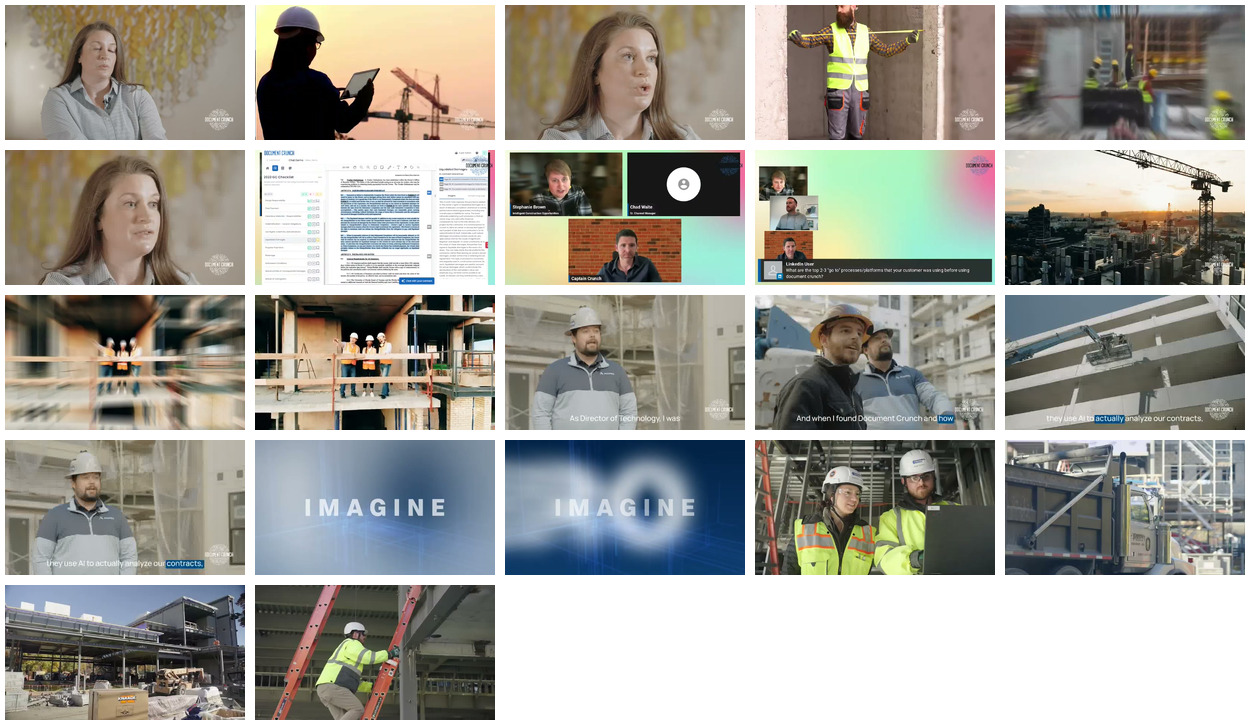
Grouped by theme, full-size and scrollable. The four public videos are marketing and testimonial films rather than product walkthroughs, so genuine product UI is scarce — only one frame captures the actual interface. That scarcity is itself a finding: the working product lives behind a login, and the public surface is brand and customer proof. Full set and method: screens/README. The whole-set contact sheet is linked at the end.
The product — the contract-review interface
The one clear product frame, from a webinar demo. Three panes: on the left a “2023 GC Checklist” listing clauses as risk items (design responsibility, final payment, hazardous materials, indemnification, lien rights, liquidated damages, progress payments, unforeseen conditions, waivers, waiver of subrogation) each marked pass / flag / watch; in the centre the source contract itself (here Article 8, Liquidated Damages for Delay) with page navigation; on the right a “Liquidated Damages — in contract references” panel citing the exact pages, with an “Insights” tab explaining the clause in plain English and a “Sample Language” alternative. A “Chat with your contract” button sits at the foot. This single screen is the whole thesis of the company: read the contract, flag the risk, cite the source, explain it plainly.
How they tell the story — the brand film
The “what is Document Crunch” film is mostly jobsite B-roll and intro animation; these frames stand in for the office-meets-field positioning rather than showing the product.
Who uses it — the customer’s voice
Customer-testimonial footage (the Document Crunch watermark and captions are visible), including Commodore Builders project staff and on-site users. Captions such as “they use AI to actually analyze our contracts” carry the message; there is no product UI in these.
The conversation around it — the webinar panel
A panel/webinar frame (a partner channel manager and others) fielding audience questions such as “what are the top 2-3 go-to processes/platforms your customer was using before Document Crunch” — useful as evidence of the go-to-market motion, not the product.
Whole-set contact sheet
For a single-glance overview of every kept frame: contact_video.jpg.
Sources and method
- Product surface, modules and how the AI works: vendor pages read directly — documentcrunch.com home, /platform, /crunch-ai, /construction-contract-review, /construction-specification-review, /procore, and the ABC partner page. Captured in
raw/RESEARCH_NOTES.json. - Boundary (prevention vs recovery), the “one-shotted” debate and dispute statistics: Bricks & Bytes coverage and the founder interview, plus the Commodore Builders case study —
raw/exa_search.json,raw/exa_answer.json,raw/RESEARCH_NOTES.json. - Funding, investors and the Trimble acquisition: Series B press (Titanium Ventures, Nemetschek and contractor LPs), ENR, Construction Dive, and the Trimble/Document Crunch acquisition announcements (2 Apr 2026) —
raw/RESEARCH_NOTES.json. - Pricing and reception: Procore Marketplace (quote-only, no free trial), third-party AI-tool aggregators (geniusfirms, velocity, logicballs, fitgap) and the G2 product page (blocked from scraping) — treated as directional given the thin independent review volume. Captured in
raw/exa_search.jsonandraw/RESEARCH_NOTES.json. - Mobile/app status: App Store search returned no genuine Document Crunch app (matched an unrelated utility) —
raw/appstore_reviews_*.jsonand the pull summary.aggregate_dom.pyand the Capterra scrape were skipped (no corpus);harvest_visuals.pywas skipped (no real app). - Screenshots and gathering method, including the video-download retries: screens/README.
- Method, limits, and the discipline of not asserting an absence without evidence: _RESEARCH-METHOD.