Dashboard: Dashboard · method: _RESEARCH-METHOD · market grid: _MARKET-PROBLEM-MAP · opportunity lens: _OPPORTUNITY-LENS · landscape: competitor-landscape-report
Purpose: decide whether Civils.ai already occupies the part of the market we want to enter first — reading tender and bid documents to flag risk and pull out requirements — or a different, adjacent part. This is the most strategically important brief in the set, because Civils.ai is the one competitor whose tender-document AI sits directly on our first paid wedge. The brief first explains what the company is and how its AI works across its three product pillars, then locates exactly where its job stops, and finally judges how much of our wedge it covers and where the open ground is. Because Civils.ai is a young, AI-native, Singapore-founded startup with no Capterra footprint and no mobile app, the evidence here is vendor product pages read directly, founder/funding press, a scatter of AI-tool aggregator entries, and three walkthrough/pitch videos — read with that early-stage caveat throughout.
Snapshot
| What it is | AI document-intelligence platform purpose-built for civil engineering and construction; reads PDF drawings, specs and contracts and turns them into measured quantities, cited answers, risk flags and compliance checks |
| Core job it does | Automates the two most document-heavy pre-construction chores — quantity takeoff from drawings, and review/search of tender, spec and contract documents — framed as “90% less manual effort” with human QA on the numbers |
| Who buys | Civil/groundworks/geotechnical estimators, pre-construction and bid teams, project managers, consultants and contractors; named users skew large (AECOM, Arup, Jacobs, WSP, Kajima, JTC, Penta Ocean, Bachy Soletanche) |
| Business model | Self-serve, published pricing, takeoff-metered: Starter US$90/mo (10 takeoffs), Professional US$270/mo (30 takeoffs), Enterprise custom; sales-led only at the top tier |
| Founded / stage | Founded 2022, HQ Singapore; pre-seed closed 2023 (Antler, Iterative, Atlas); ~15 staff across 4 cities; led by ex-Arup/Morgan Sindall civil engineer Stevan Lukic |
| Openness | Enterprise tier exposes an API and MCP server plus SSO/SAML; exports to Excel, Word and Power BI; no public self-serve API on lower tiers; no verified BIM/CAD live integration |
| Scale claims | 200+ contractors and consultants, 8 countries, $3bn+ project value processed, 430,000+ tasks automated, 97% accuracy on modern PDFs |
| Strongest areas | Estimating/takeoff (quantities); RFI/spec/document control via Q&A; bid & tender document review |
| Weakest areas (our interest) | Cost/pricing of any kind (quantities only, “no numerical reasoning”); historical-cost benchmarking; change/variation/claims; field capture |
| Our verdict | The clearest direct overlap with our tender wedge — but it stops at quantities and document Q&A and never crosses into cost, pricing or benchmarking; flank where it cannot reach |
Civils.ai was founded in 2022 by Stevan Lukic, a civil engineer who spent roughly eight years at Arup and Morgan Sindall, together with Mirko Vairo (COO, ex-strategy consultant and prior AI-SaaS founder) and Mohamad Fadil (CTO). The company is headquartered in Singapore, closed a pre-seed round in 2023 (backers named as Antler, Iterative and Atlas), and runs a roughly 15-person team across four cities. The founding insight is the one our own thesis rests on: civil and construction projects are defined by enormous volumes of documents — site investigation reports, specifications, contracts, tender packages, drawings — and the work of reading, measuring and cross-checking them is slow, manual and expensive. Civils.ai applies a construction-trained LLM and a measurement engine to that pile. The product began (2022-23) as a constrained document-Q&A chatbot (“ask questions about your project documents, get cited answers, no hallucinations”) and has since pivoted its commercial centre to AI quantity takeoffs, which is what the pricing now meters. That evolution matters for everything below: the tender-review capability we care about is real, but it is one of three pillars and not the one the money is built on.
Where Civils.ai plays across the market
Scored 0 (not addressed) to 100 (best-in-class) against the 21 areas in _MARKET-PROBLEM-MAP, sorted by coverage. This is a deliberately narrow pre-construction tool, so all field, schedule, finance and lifecycle rows are near zero by design.
| Problem area | Coverage | Note |
|---|---|---|
| Estimating / takeoff | 70 | The commercial core now: AI quantity takeoff from PDF drawings across trades, human-QA’d. Quantities only — no pricing |
| RFIs / submittals / document control | 60 | Document Q&A with page-cited answers across drawings, specs, contracts; “Google for your project documents” |
| Bid & tender management | 55 | Reads tender packages: flags clauses/risks/obligations, extracts submission dates and deliverables, re-runs bid checklists. Review side only — no opportunity sourcing or bid tracking |
| Quality / QA-QC / snagging | 35 | Compliance/spec checks against codes of practice; cross-checks subcontract scope vs client requirements for gaps |
| Reality capture / survey (geotech) | 35 | Borehole PDF digitiser, subsurface visualisation, 2D section + 3D ground modelling from site-investigation reports |
| Prequalification / procurement | 25 | Scores subcontractor options with decision matrices; checks subcontract scope against client requirements |
| Insurance and risk | 25 | Contract risk flagging (NEC/JCT/FIDIC clauses, exclusions, obligations) — read, not register |
| Project management (system of record) | 15 | A per-project document workspace, not a system of record |
| Communication / client collaboration | 15 | Share access, collaborate on checks; export to Excel/Word/Power BI |
| Cost management / forecasting | 10 | Touches the estimate by producing the quantities, but holds no rates, no cost, no money |
| Change / variations / claims / entitlement | 5 | Not addressed; contract-clause reading could inform it, but there is no claims workflow |
| Historical cost / benchmarking | 5 | Explicitly absent — “no unit rates, cost data, pricing or historical benchmarking.” Our moat is untouched |
| Scheduling / programme | 5 | Can extract dates/deliverables into a checklist; no programme |
| BIM / design coordination | 5 | Reads PDF drawings, not 3D models; “may not yet integrate with major BIM/CAD” |
| Progress / production tracking | 0 | Not addressed |
| Field management / daily reporting | 0 | Not addressed (no mobile app) |
| Time, labour and workforce | 0 | Not addressed |
| Safety and compliance (site) | 0 | Document compliance, not site safety |
| Accounting / AP-AR / payroll | 0 | Not addressed |
| O&M / handover | 0 | Not addressed |
| Equipment / asset / material | 0 | Not addressed |
Takeaway: Civils.ai concentrates in exactly three places — quantity takeoff, document Q&A/control, and tender/spec/contract review — with a fourth specialised pocket in geotechnical/subsurface. It sits on the same documents our wedge cares about (tender packages, specs, contracts) and, unlike most of the set, it genuinely reads them on the bid side: clauses, risks, obligations, deadlines. That is the overlap to take seriously. But the two areas central to our durable thesis — turning quantities into priced, benchmarked bids (cost and area 21) and recovering money from changes (area 15) — are exactly where the product stops by its own admission. The rest of this brief is about how deep the tender overlap really is, and what the deliberate absence of cost means for us.
The input side — how work gets captured
- Captured: the documents and drawings the user uploads — PDF drawings (including scanned, handwritten and historic), specifications, contracts and tender packages, site-investigation/geotechnical reports, and codes of practice. Each document can be very large (early press cited up to 2,000 pages per file).
- Input methods: browser upload to a per-project workspace, then one of two paths — (a) pick an “AI agent” and type a prompt/search/check, or (b) run a takeoff on a drawing sheet. No mobile capture; this is desk work on documents that already exist.
- How the AI reads it (vendor’s account): a construction-trained LLM refined on 100,000+ public datasets for construction document formats and jargon; answers are constrained to the uploaded data and cited to the exact page/section so users “click through to verify in one tap” — the same anti-hallucination grounding pattern as the rest of the document-AI cohort. For takeoffs, the measurement engine reads areas, lengths, volumes, counts and elevations from a drawing sheet, then a human QA team reviews every result before delivery (within 24 hours).
- Friction (from third-party reviews): an initial learning curve on prompt/query style; lower accuracy on pre-1975 or poor-quality scans; no numerical reasoning or calculation (it extracts numbers, it does not compute with them); PDF-only (no native CAD spatial analysis); and CAD-drawing takeoffs can take up to 24 hours. These are the recurring criticisms across the aggregator pages.
The management side — what the office sees
- Lands in the workspace: for takeoffs, an annotated/marked-up drawing plus a quantities table exported to Excel/PDF, editable in-browser. For document work, cited answers to typed questions, a checklist of extracted submission dates/review periods/deliverables, a clause-and-risk read across contracts (NEC/JCT/FIDIC), and compliance/gap checks cross-referencing subcontract scope against client requirements. Outputs can go to Excel, Word or Power BI dashboards.
- Who consumes: estimators and pre-construction/bid teams (the takeoff and tender-review users), project managers and quantity surveyors (document search and obligation tracking), and geotechnical engineers (the subsurface tools). The buyer is the office pre-construction desk, not the field.
- Valued most: speed on otherwise brutal manual jobs — “cut takeoff time by up to 90%,” “saved hours every week digging through geotechnical reports,” “for tender submissions it cuts through the fluff and gives us the data we need” — and the cited, auditable output that lets a professional trust and defend the result.
- The structural boundary (evidenced): every output is a quantity or a cited reading. The product measures and surfaces; it does not price, cost, benchmark or compute. It will tell you there are 1,240 m of drainage on the sheet and which clause carries the liquidated-damages risk; it will not tell you what that drainage should cost, how this bid compares to the last three similar jobs, or how to build a variation claim when the work changes. That boundary — measure-and-read, but never cost-and-recover — is the whole strategic question for us, examined below.
Where the value actually comes from
| Sales story (what wins the trial) | Real source of stickiness (what makes it hard to leave) |
|---|---|
| Do a day of takeoff in minutes; ask your tender pack a question and get a cited answer; flag the contract risk before you price the bid — all without writing code | A construction-trained model plus a human-QA loop that delivers numbers an estimator will actually submit; the cited audit trail; per-project workspaces that accumulate a firm’s documents; and the named-client proof (AECOM, Arup, WSP, Kajima) that de-risks adoption inside large engineering firms |
- Do not attack: the takeoff measurement engine plus its human-QA loop, and the document-Q&A read. These are the company’s core, genuinely construction-specific, and the QA loop in particular is operationally hard to stand up — it is people plus model, not just a wrapper. Trying to out-measure Civils.ai on PDF takeoff is the wrong fight.
- Where value stops: at the quantity and the citation. Civils.ai converts drawings into measured numbers and documents into cited answers and risk flags. It does not convert those numbers into a priced, benchmarked bid, and it does not convert project events into recovered money. It has told the market, in its own pricing FAQ and its review profiles, that it holds no rates, no cost data and no benchmarking. That is not a gap we have to infer — it is a stated boundary, and it is precisely our ground.
What users say — both sides
Credibility first: Civils.ai is an early-stage AI-native vendor with very little independent review volume — there is no Capterra corpus, no G2 review count we could verify, and no mobile app to rate, so there are essentially no organic, statistically meaningful third-party reviews. What exists is (a) the vendor’s own pages and case studies, (b) a large set of AI-tool aggregator listings (toolbit, usethisai, groupify, futurepedia, eliteai, findaitools and similar) that mostly paraphrase the vendor and carry tiny or zero review counts, and (c) two pieces of real trade press — a 2023 Construction Management interview with the founder, and 2025-26 review write-ups. Treat all star ratings here as directional, not evidence. The strongest real signals are not stars; they are the named enterprise logos (AECOM, Arup, Jacobs, WSP, Kajima, JTC, Penta Ocean), the $3bn+ processed claim, and the founder’s pedigree — the market is validating the takeoff-and-document job even though the public review trail is thin.
| Praised | Criticised |
|---|---|
| Specialised for construction terminology and document structures; beats general LLMs on AEC docs | No numerical reasoning or calculation — extracts numbers, does not compute |
| Cited, marked-up answers linked to the source page; trustworthy/auditable | PDF-only; no CAD spatial analysis; weak on pre-1975 or poor scans |
| Up to 90% less manual takeoff effort; “saved hours every week on geotechnical reports” | Takeoffs can take up to 24 hours; initial learning curve on querying |
| No-code custom checks/workflows; reusable templates | Tiered pricing and the token/takeoff consumption model seen as not fully transparent for larger teams |
| Human-QA on every takeoff result; data not used for model training; private-cloud option | Thin/no deep BIM/CAD integration; young ecosystem |
- Signal for us: the single most useful line across all reviews is “no numerical reasoning and calculations.” A tool that does construction takeoff but cannot price, compute or benchmark has drawn its own boundary exactly where our value begins. The other recurring note — pricing/consumption opacity at scale — says a transparent, outcome-priced offer lands on a real friction, the same way it did against the sales-led incumbents.
The opportunity for AI in this space
- AI is the product here, and it is real and shipped. Unlike a field-reporting incumbent where AI is polish, Civils.ai’s entire value is LLM-shaped work: reading dense civil-engineering documents and measuring drawings. This is squarely the work cheap models now do well, and the vendor has shipped it to paying enterprise users. So the question for us is not whether this job is AI-amenable — Civils.ai proves it is — but which adjacent slice of it is left open.
- The open slice is the money. Civils.ai produces the quantity; the next, more valuable steps — attaching rates to build a priced bid, benchmarking that bid against a firm’s own history of similar jobs, and pursuing variations/claims when the work changes — are even more LLM-shaped and even more data-compounding, and Civils.ai has explicitly chosen not to do them (“no rates, no cost, no benchmarking”). That choice is rational for them (pricing data is sensitive, firm-specific and where the liability sits) but it is exactly the compounding-data loop our thesis is built on: every priced bid and every job outcome makes the next price better.
What we would build:
- Baseline to respect: we do not need to out-measure Civils.ai on raw takeoff; we need takeoff good enough to feed a price, and then go where it does not — turning the quantities and the tender read into a priced, risk-adjusted bid.
- The job to own: the commercial half of pre-construction — pricing the takeoff against the firm’s own historical cost data (area 21), surfacing the tender’s risk-and-obligation read into a bid/no-bid and a margin decision (area 1), and later the variation/claim recovery (area 15). Civils.ai stops at quantities and citations; the priced, benchmarked decision is open.
- Niche to target first: UK/commonwealth mid-market civil and groundworks contractors and subcontractors who already feel the takeoff pain Civils.ai sells into, but who price and bid on spreadsheets and tribal knowledge with no benchmarking — the tender-intelligence wedge, expanding into historical-cost benchmarking.
How open the platform is
- Surfaces and integrations: browser web app only (no mobile). Outputs export to Excel, Word and Power BI. An API and an MCP server plus SSO/SAML are gated to the Enterprise tier — notable, because MCP exposure means the product is being positioned to be driven by other agents, not just to drive its own UI. There is no self-serve public API on the lower tiers, and no verified live BIM/CAD integration (reviews flag the young integration ecosystem).
- What it means: for most buyers Civils.ai is a closed app you log into, so building on top of its data is only realistic at the Enterprise tier via the API/MCP — which also means a large customer could wire Civils.ai’s takeoff output into our pricing/benchmarking layer rather than the reverse. The openness cuts in our favour at the seam we care about: Civils.ai is happy to hand off the quantity (it even exposes MCP to do so), and the priced, benchmarked decision that consumes the quantity is the part it does not build. That makes a build-alongside posture viable — consume their (or our own) takeoff, own the cost/benchmarking layer they decline to touch.
Civils.ai’s own AI — claims, shipping, and how far they can go
Civils.ai is the case where the competitor’s AI is the product, shipped and in real enterprise use, not a slide. So the question is not “can they ship AI” — they have — but “how far does their shipped AI reach into our wedge, and will they extend it into cost and benchmarking.”
| Shipped capability | What it does | Pillar | Status |
|---|---|---|---|
| AI quantity takeoff | Measures areas/lengths/volumes/counts/elevations from PDF drawings across trades; human-QA’d; exported annotated | Takeoff | GA (the metered core) |
| Document Q&A (“search”) | Cited natural-language answers across drawings, specs, contracts; unlimited searches | Documents | GA |
| Specs & contract checks | Flags NEC/JCT/FIDIC clauses, exclusions, obligations, risks; extracts deadlines/deliverables to a checklist; re-runnable bid checklists | Tender/contract | GA |
| Compliance / gap checks | Cross-checks subcontract scope vs client requirements; checks against codes of practice | Tender/QA | GA |
| Geotech / subsurface | Borehole PDF digitiser, subsurface visualisation, 2D section + 3D ground modelling | Geotech | GA |
| Custom AI bots / no-code workflows | Users build reusable checks/workflows for their own templates | Cross-cutting | GA |
| API & MCP server | Enterprise: programmatic access and agent-driveable interface | Platform | GA (Enterprise tier) |
| Advanced multi-step agents | ”Agents that go beyond simple searches and checks” | Cross-cutting | Beta / custom-priced (announced, gated) |
- The tender-review reach is genuine but quantity-and-read deep, not decision deep. On the bid side it really does read tender packages, flag contractual risk, pull obligations and deadlines into a checklist, and re-run a bid checklist across a package — that is more than horizontal doc-Q&A; it is a purpose-built tender-review capability. But it ends at the read: a cited risk flag and a requirements checklist. It does not produce a bid/no-bid recommendation, a priced bid, or a margin/risk position. It informs the human’s tender decision; it does not make it.
- How far they can take it: very far on measuring and reading, and they are clearly extending into agentic multi-step workflows (announced, gated to custom pricing). But a move into cost and benchmarking is a different and harder thing: it requires firm-specific rate data they have deliberately stayed out of, it carries pricing liability, and their entire pitch and proof (“no numerical reasoning,” “your data is never used for training”) is built around not holding or computing money. Their roadmap momentum points at more agents over the same documents, not at becoming a pricing/benchmarking engine.
- Confidence they extend into cost/historical-cost benchmarking within ~2 years: low (about 1 in 4). Reasons: it is a different data asset (firm cost history, not public documents), a different liability posture, and against their stated positioning; their commercial momentum is in metered takeoffs and gated agents, pulling effort toward more measurement, not toward pricing. Main risks to this read: (a) they are early-stage and could pivot fast on a new round, and (b) a well-capitalised entrant or an estimating incumbent could bolt cost onto their takeoff. The talk-vs-ship gap here is narrow (they ship what they say) — so the window is not “they can’t move,” it is “they’ve chosen a different door.”
Who actually uses Civils.ai
There is no review corpus to segment by firm size, so this is drawn from named customers, the founder interview and aggregator profiles, and is directional.
- Firm profile: the visible base skews to large engineering consultancies and contractors — AECOM, Arup, Jacobs, WSP, Kajima, Penta Ocean, JTC (Singapore) and Bachy Soletanche are named, alongside a stated “200+ contractors and consultants” across 8 countries. The self-serve $90-$270 tiers also make it reachable by small estimating teams and freelancers, so the range is wide; the proof, though, is being built on big logos.
- Role: the document-Q&A interview lists M&E site managers, project managers, quantity surveyors and senior PMs as the early users; the takeoff pivot adds estimators and pre-construction/bid teams; the geotech tools add geotechnical engineers. The common thread is the pre-construction and document-heavy desk, not the field.
- Why they adopt: the testimonials are consistent and specific — “saved hours every week digging through geotechnical reports on a £20M highway scheme,” “for tender submissions it cuts through the fluff,” “do a day of takeoff in minutes.” The verbs are measure, search, check, extract — never price, benchmark, recover.
- Alternatives in the same conversation: on the document/compliance side, Document Crunch and Cogram; on takeoff/estimating, Kreo, Togal and Pelles; on the broader management side, Constructable, AI Clearing and Procore appear in comparison pages. None of those alternatives pairs construction takeoff with historical-cost benchmarking either — the benchmarking ground is empty across the whole comparison set.
Our read — can we enter and win?
Civils.ai is the most important competitor in this set for us, because it is the only one whose shipped product touches our first paid wedge directly: it reads tender and bid documents, flags contractual risk, and extracts requirements and deadlines — the exact tender-intelligence job we mean to start with. We should be honest that this is a real overlap, not a shallow demo: the tender-review capability is purpose-built, cited and in enterprise use. But the overlap is bounded with unusual precision by the company’s own statements. Civils.ai measures and reads; it does not cost, price, benchmark or recover. It produces the quantity and the cited risk flag; it stops before the priced, risk-adjusted, benchmarked bid decision — and it has explicitly and repeatedly said it holds no rates, no cost data and no historical benchmarking. Area 21, our moat, is empty. Area 15, claims recovery, is empty. The half of pre-construction that turns documents and quantities into a commercial decision is exactly the half it declines to build.
So the entry is not a head-on fight on takeoff or document-Q&A — we would lose that, and we do not need to win it. The entry is the commercial layer that consumes what Civils.ai (or our own thin takeoff) produces: price the takeoff against the firm’s own job history, turn the tender’s risk-and-obligation read into a bid/no-bid and a margin position, and compound a benchmarking dataset that gets better every job. Because the Enterprise tier even exposes an API and MCP server, a build-alongside posture is technically viable — take the quantity, own the price. The thing that would make us walk away is a well-capitalised move — by Civils.ai on a fresh round, or by an estimating incumbent (Kreo-class) bolting historical-cost benchmarking onto an existing takeoff engine — that closes the cost-and-benchmarking gap before we establish our own data loop. The talk-vs-ship gap here is narrow, so our edge is not their slowness; it is that they have deliberately chosen a different door, and we should run through ours before someone reconsiders.
| Question | Our read |
|---|---|
| Where is Civils.ai strong and off-limits? | PDF quantity takeoff with a human-QA loop, and cited document Q&A on civil-engineering documents. Backed by a construction-trained model and large named clients |
| Where is the verified gap? | Cost — pricing the takeoff, benchmarking against the firm’s own history (area 21), and turning the tender read into a bid/no-bid and margin decision. It holds no rates, cost or benchmarking by its own account |
| Does it overlap our tender wedge (area 1)? | Yes, directly — it reads bid-side tender packages, flags contractual risk and obligations, extracts deadlines/deliverables, and re-runs bid checklists. But only the read, never the priced decision |
| How hard for them to follow us into cost/benchmarking? | Different data asset (firm cost history), different liability, against their stated positioning and momentum. Capability-adjacent but incentive-distant |
| How much can cheap AI do in the open job? | A great deal — pricing, risk-adjusting and benchmarking a bid is generative and document-heavy, with a strongly compounding cost-data loop |
| Is there a cheap, narrow way in that grows? | Yes — a tender-intelligence wedge (bid/no-bid + risk + price) that consumes a takeoff, expanding into historical-cost benchmarking, which Civils.ai declines to touch |
| What would make us walk away? | A funded move — by Civils.ai post-raise, or an estimating incumbent — that bolts historical-cost benchmarking onto a takeoff engine before our data loop exists |
| Overall | Direct overlap on the tender read, but they stop at quantities and citations; enter on the priced, benchmarked commercial decision they decline to build, and flank into UK/commonwealth mid-market civils |
The product / availability
Civils.ai is web/SaaS only — a browser application you log into, organised as per-project document workspaces. There is no Civils.ai mobile app: an App Store search (US and GB) for “Civils.ai” returned only unrelated general-purpose AI chat apps (Claude, Meta AI, Perplexity and the like), with no Civils.ai listing in either store. That fits the buyer and the job — takeoff, tender review and document search happen at a desk on documents that already exist, not in the field. The geotech tools and the document workspace are explicitly browser-based, and the pricing page lists no native mobile or offline mode.
| Surface | What it is | Status |
|---|---|---|
| Web app | Takeoff, document Q&A, specs/contract checks, geotech, custom bots | GA |
| Exports | Excel, Word, Power BI dashboards; annotated PDF takeoffs | GA |
| API & MCP server | Programmatic + agent-driveable access | GA (Enterprise tier only) |
| SSO / SAML, custom DPA, private cloud | Enterprise security/deployment | GA (Enterprise tier) |
| Mobile app | None | Not offered |
| Free tier | None currently on the pricing page (older aggregators cite a freemium/trial; not present now) | Not offered |
Screenshots
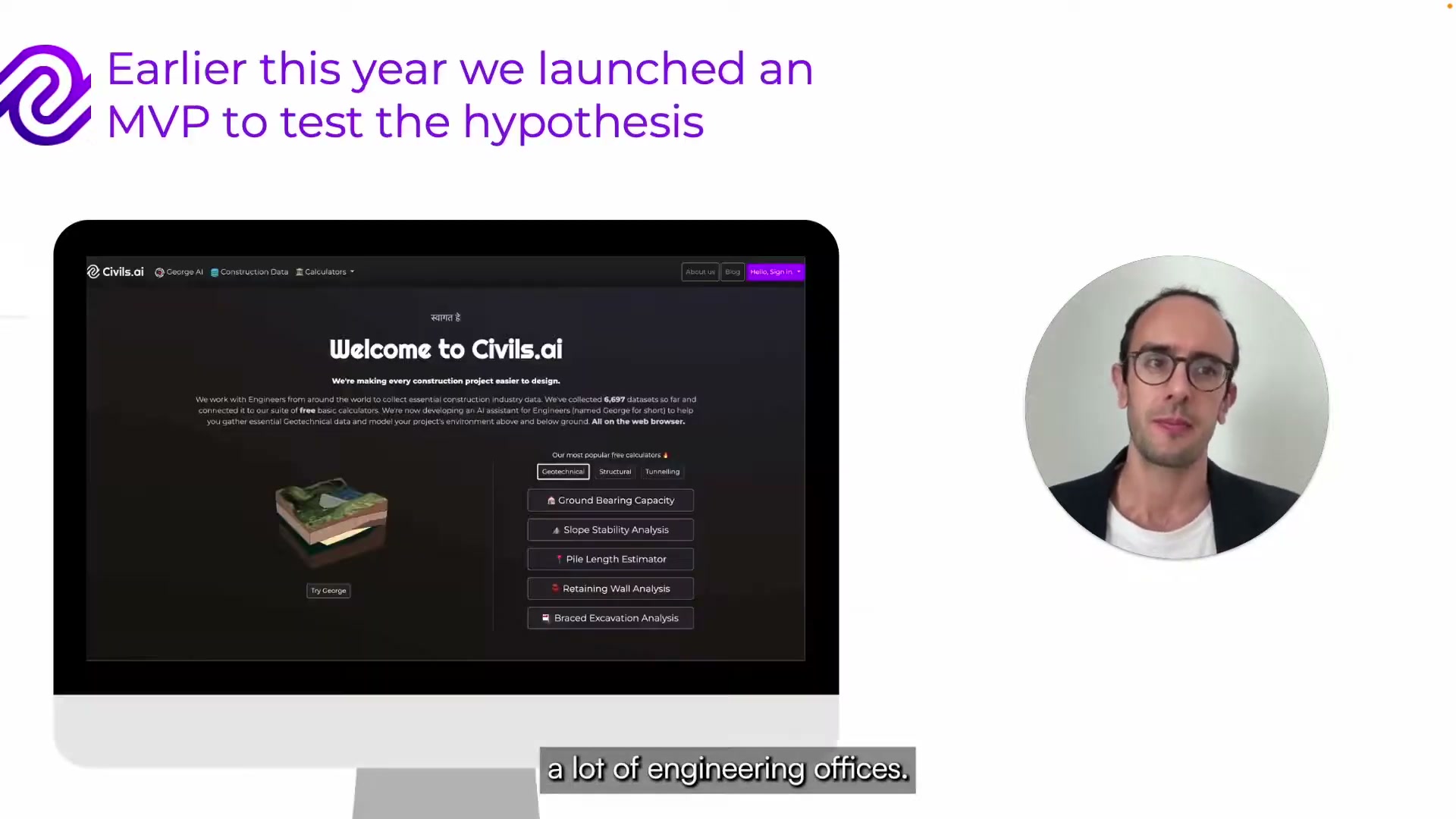
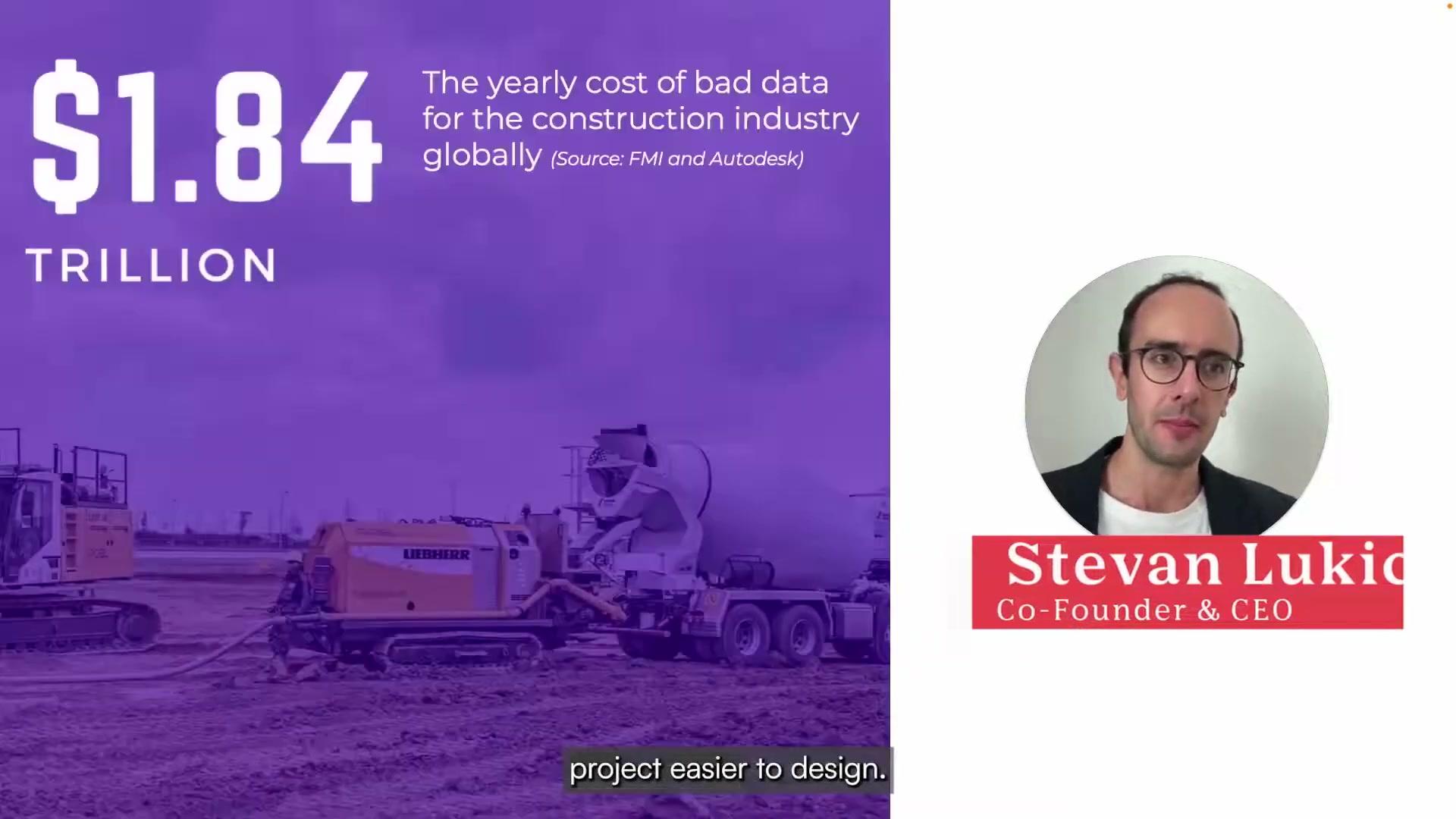
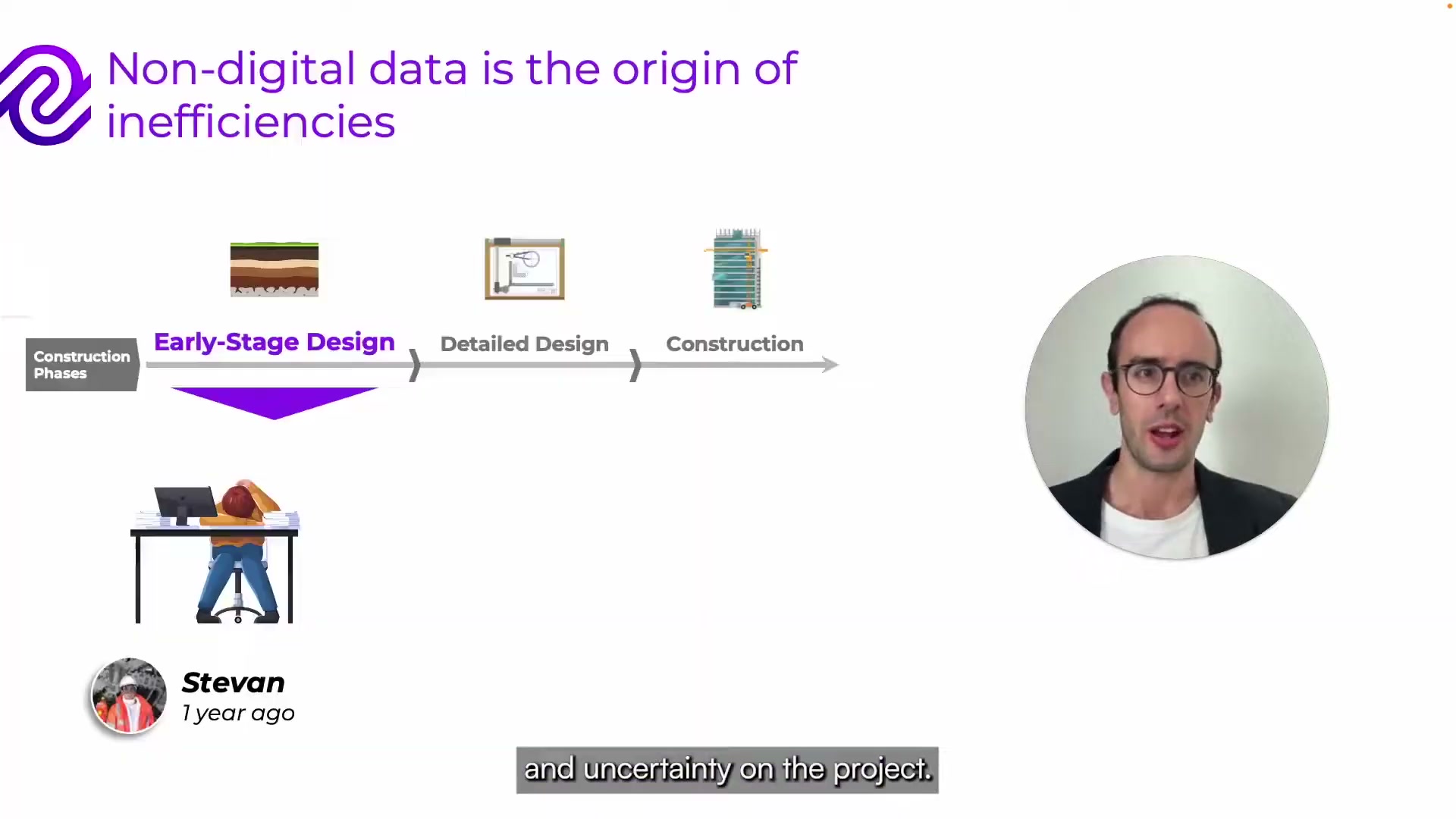
Grouped by theme, full-size and scrollable. Images render in Obsidian and exported HTML through embeds (referenced, not copied). The three public videos are a mix of a product walkthrough/demo, an early investor-style pitch (growth charts, team slide) and a geotechnical-tool walkthrough, so genuine product UI is partial — the clearest interface frames come from the geotech tool and the demo’s document view. That the marketing surface leans on pitch and brand frames is itself a finding: this is a young company still telling its story as much as showing its product. Full set and method: screens/README. The whole-set contact sheet is linked at the end.
The document workspace — the Q&A core
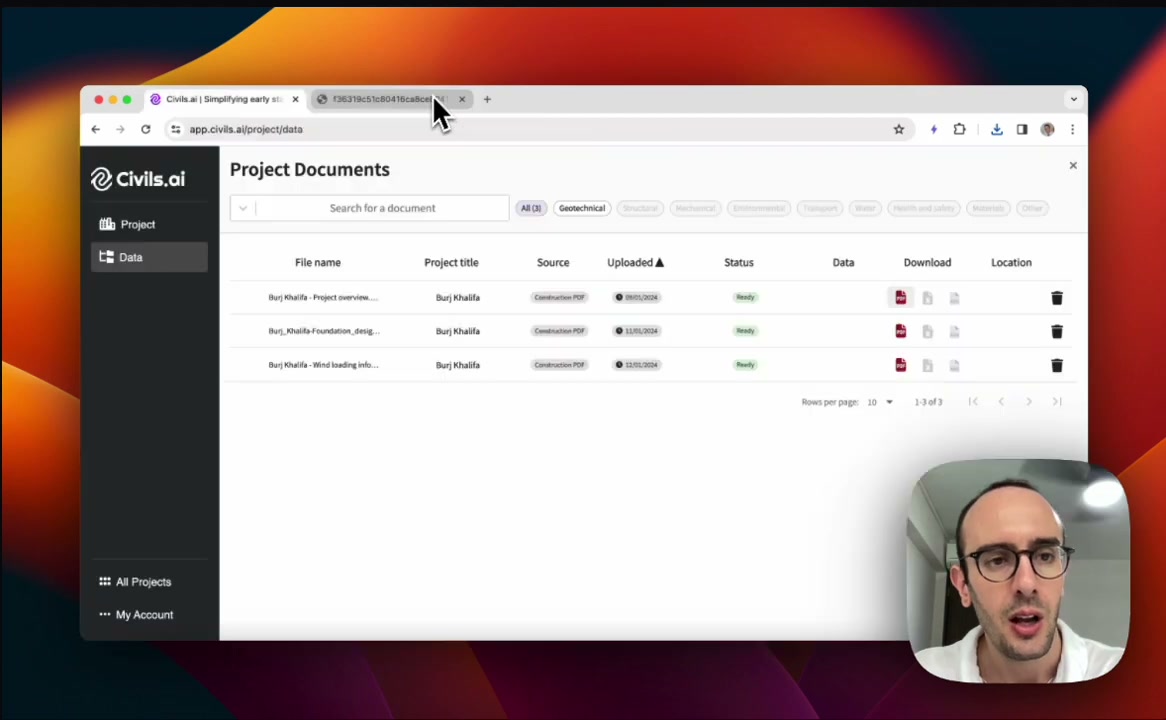
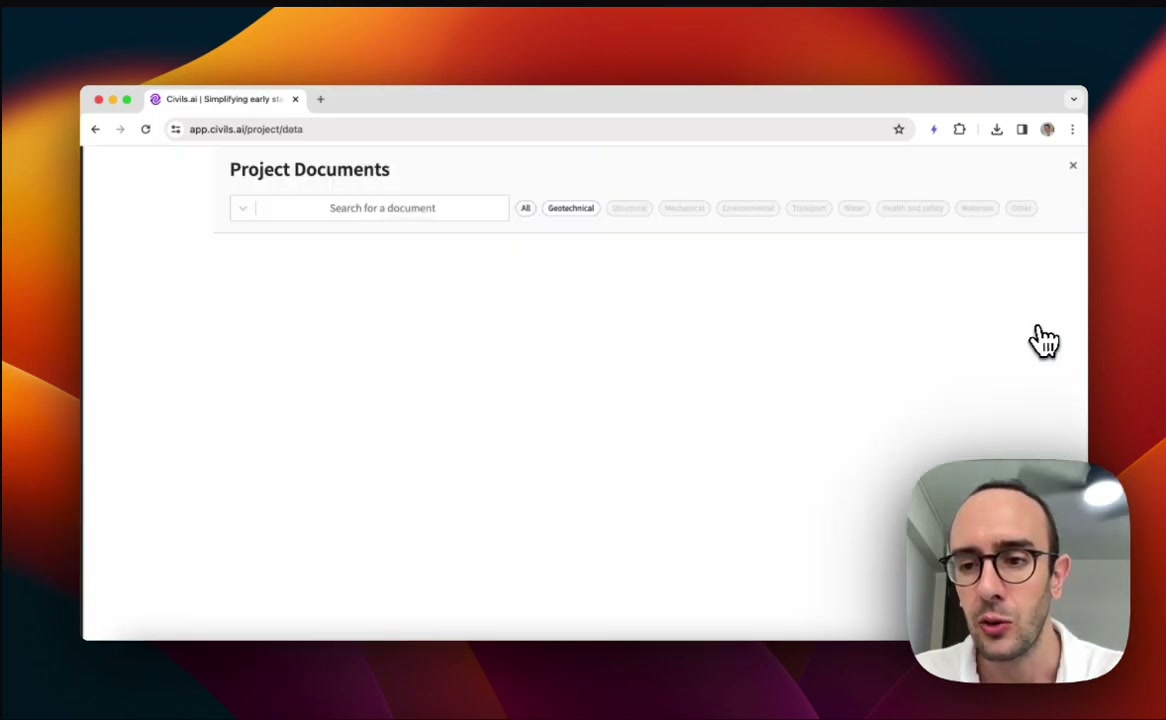
The web app’s project document view (app.civils.ai/projects): a “Project Documents” search bar with filter tabs (All, Geotechnical, and other document categories) over an uploaded project’s files. This is the document-Q&A heart of the original product — upload a project’s documents, then search or ask across them.
The geotechnical tool — boreholes and subsurface
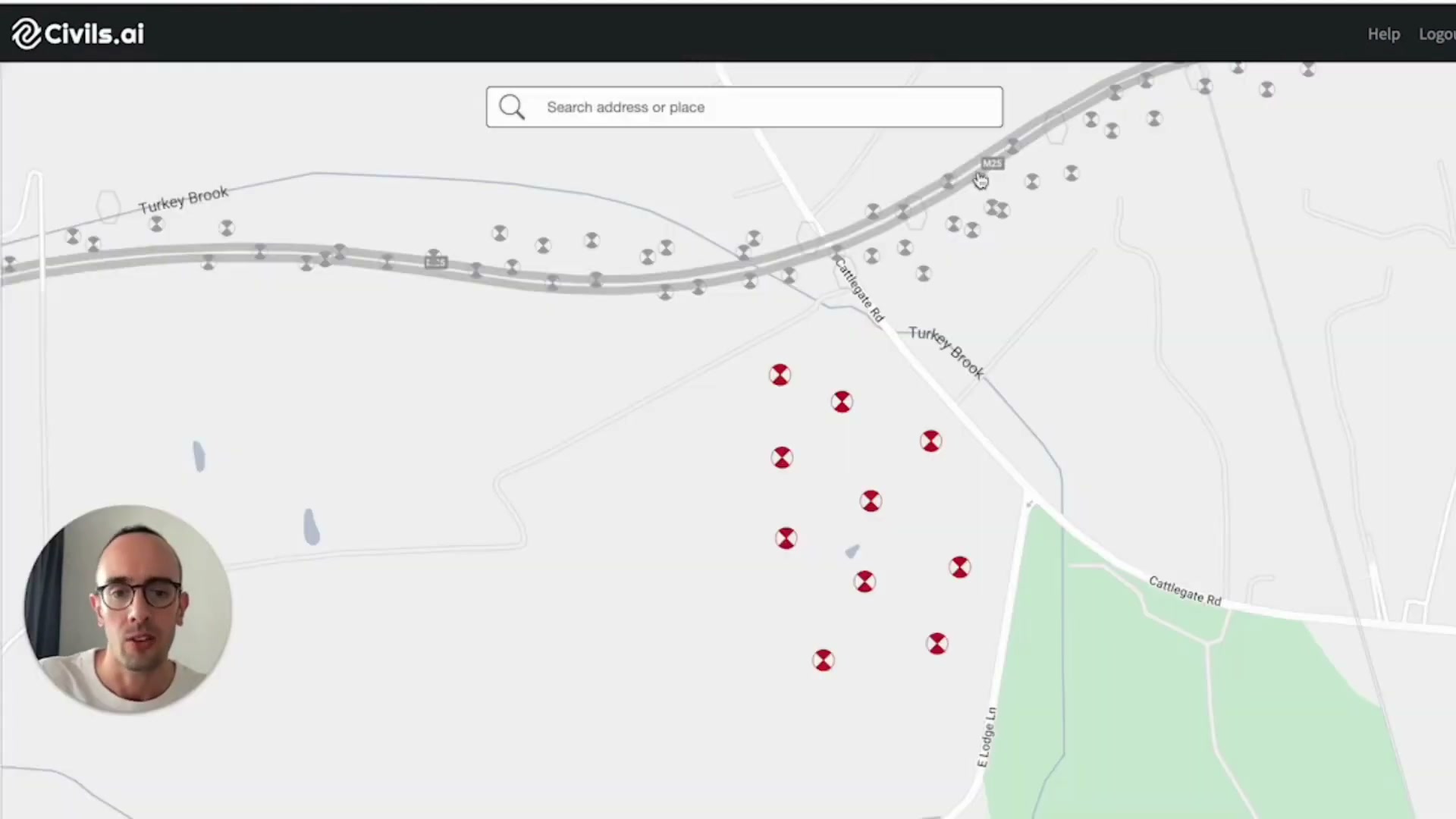
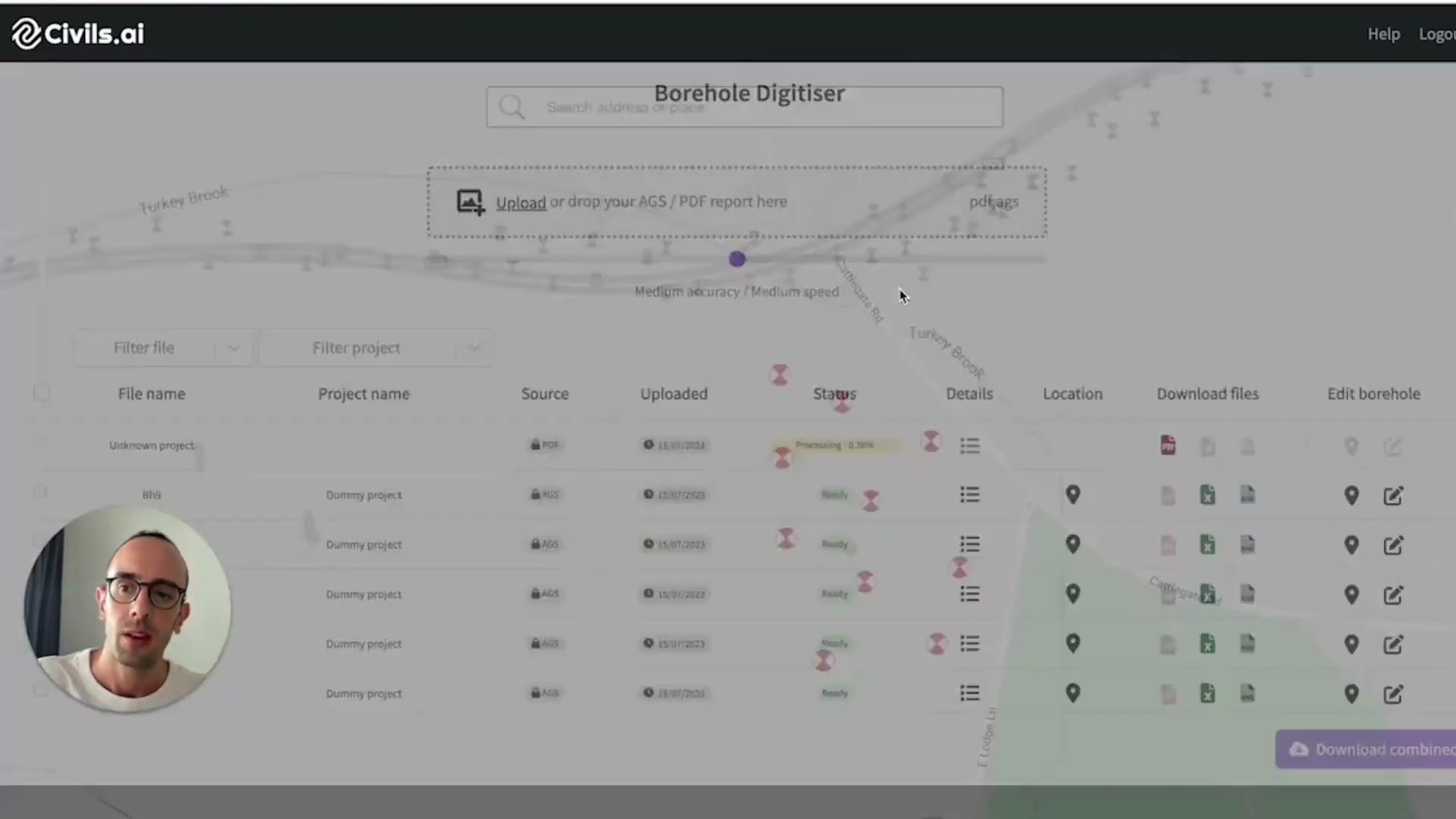
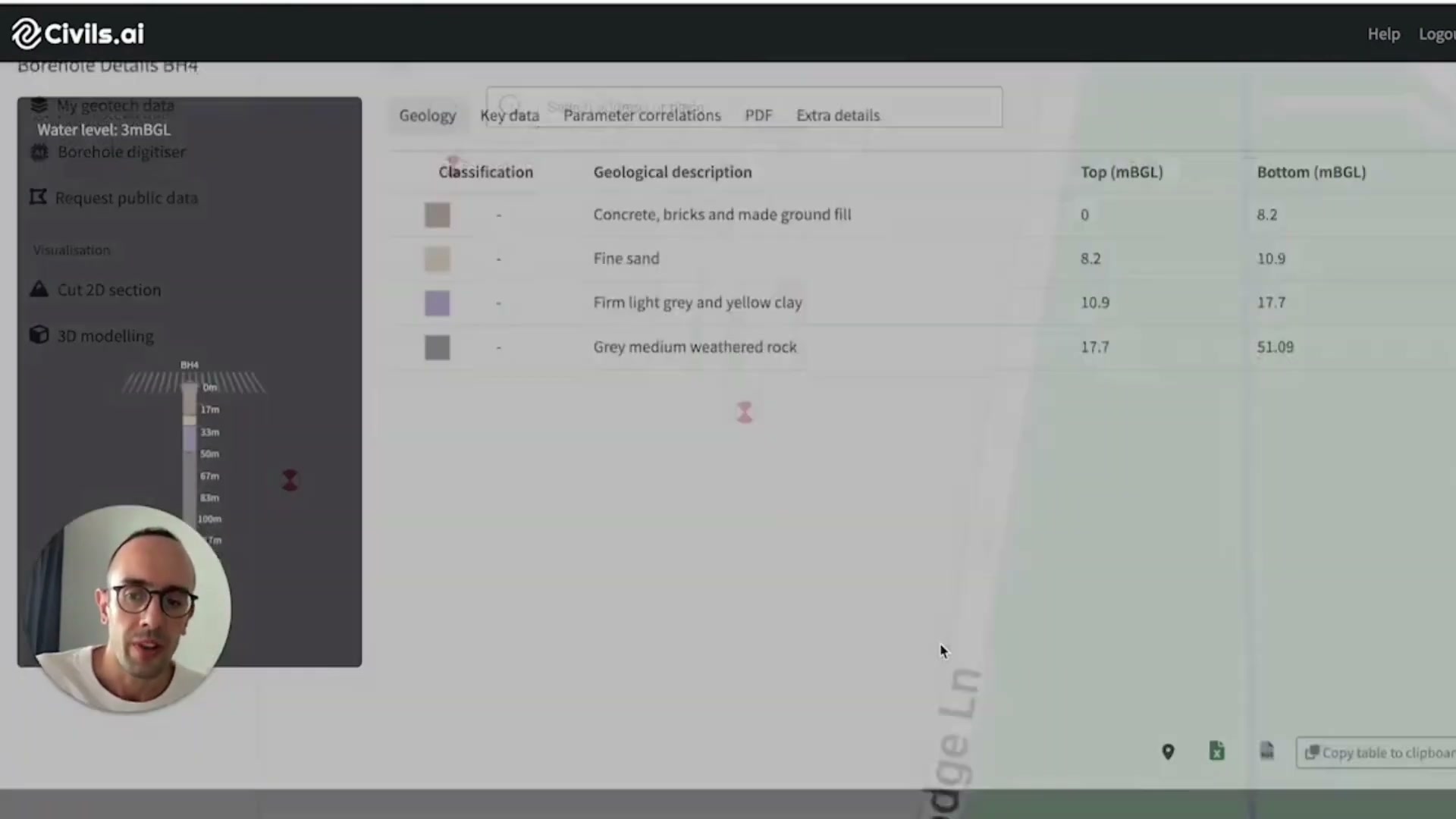
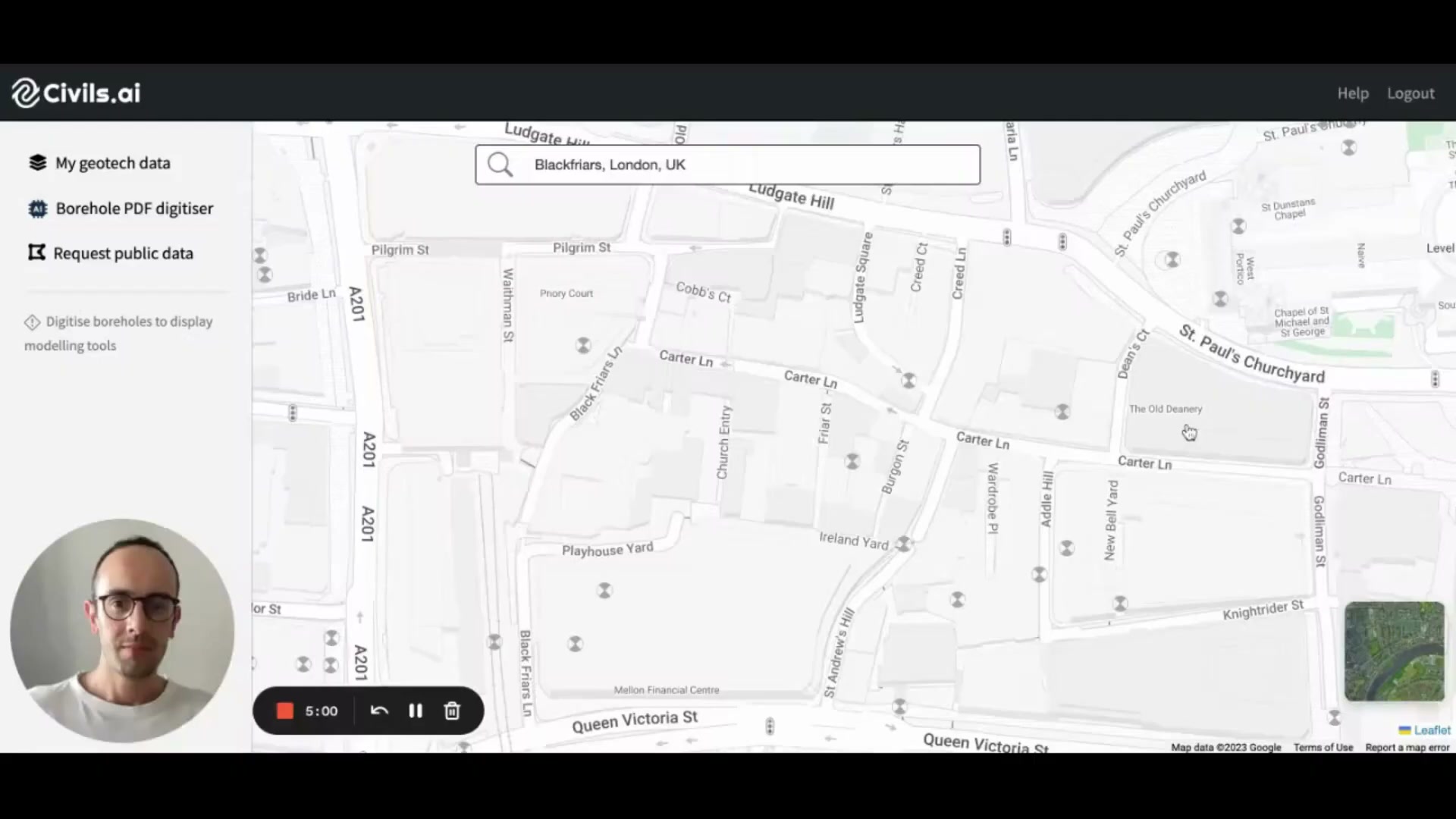
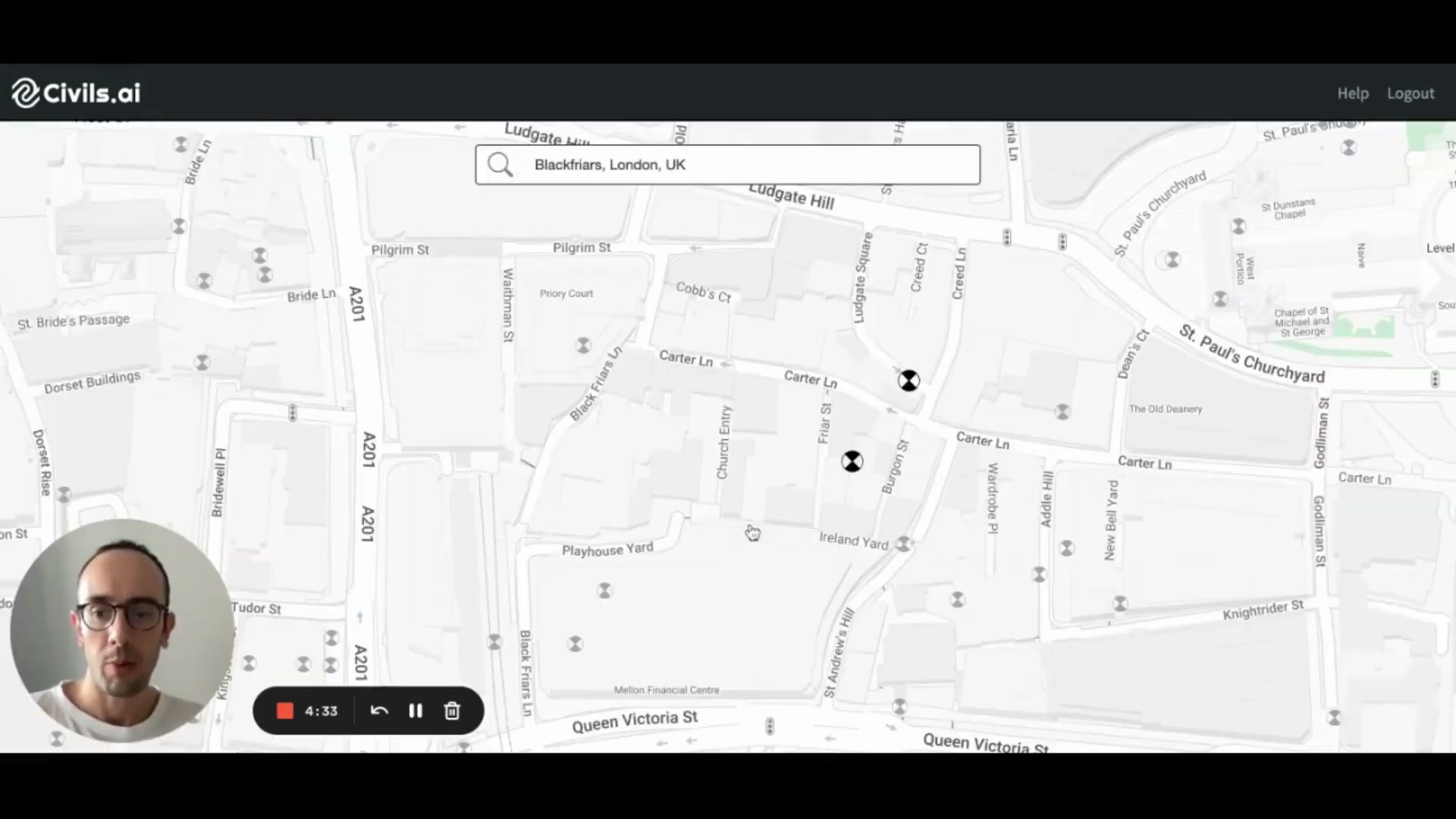
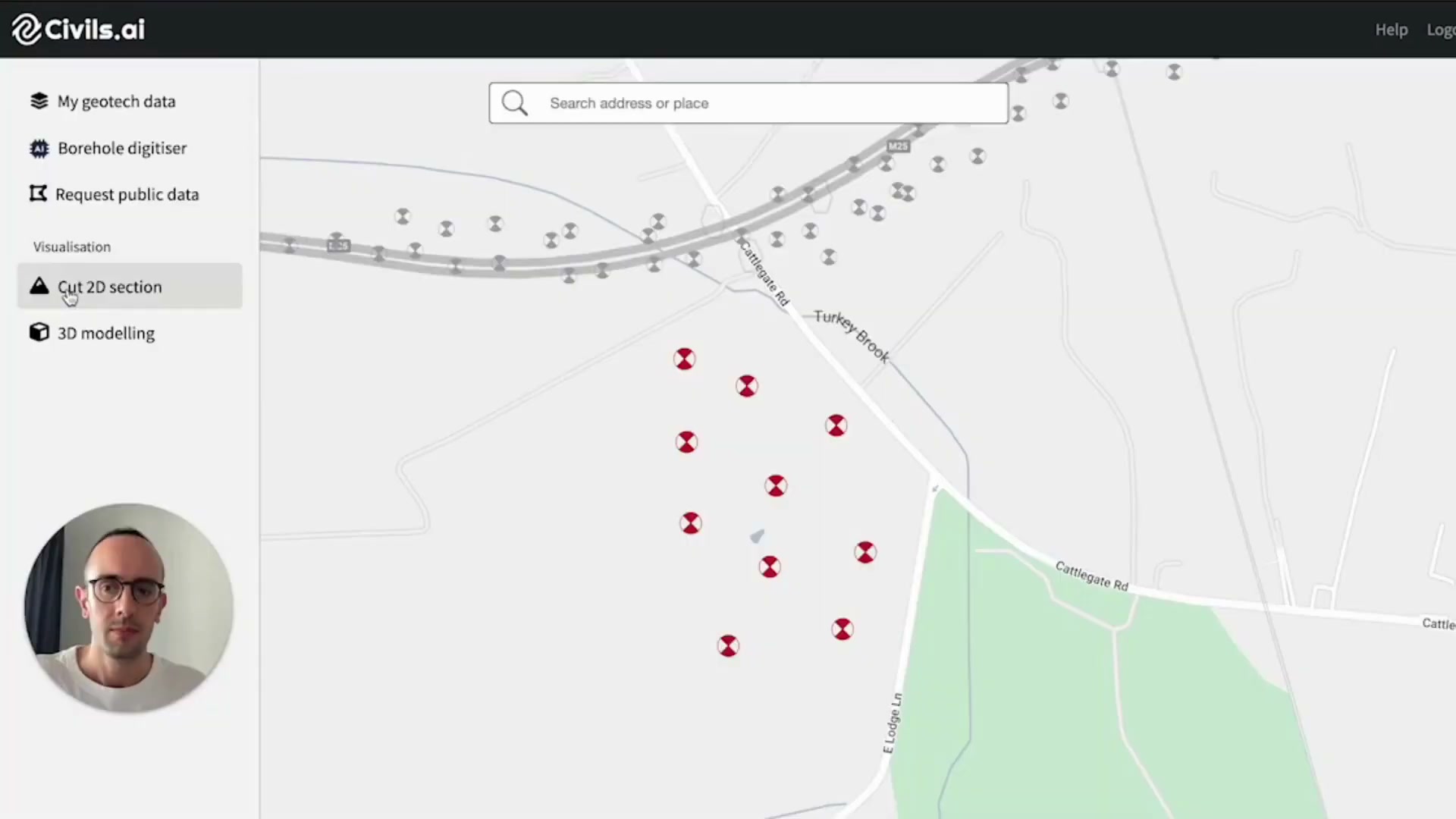
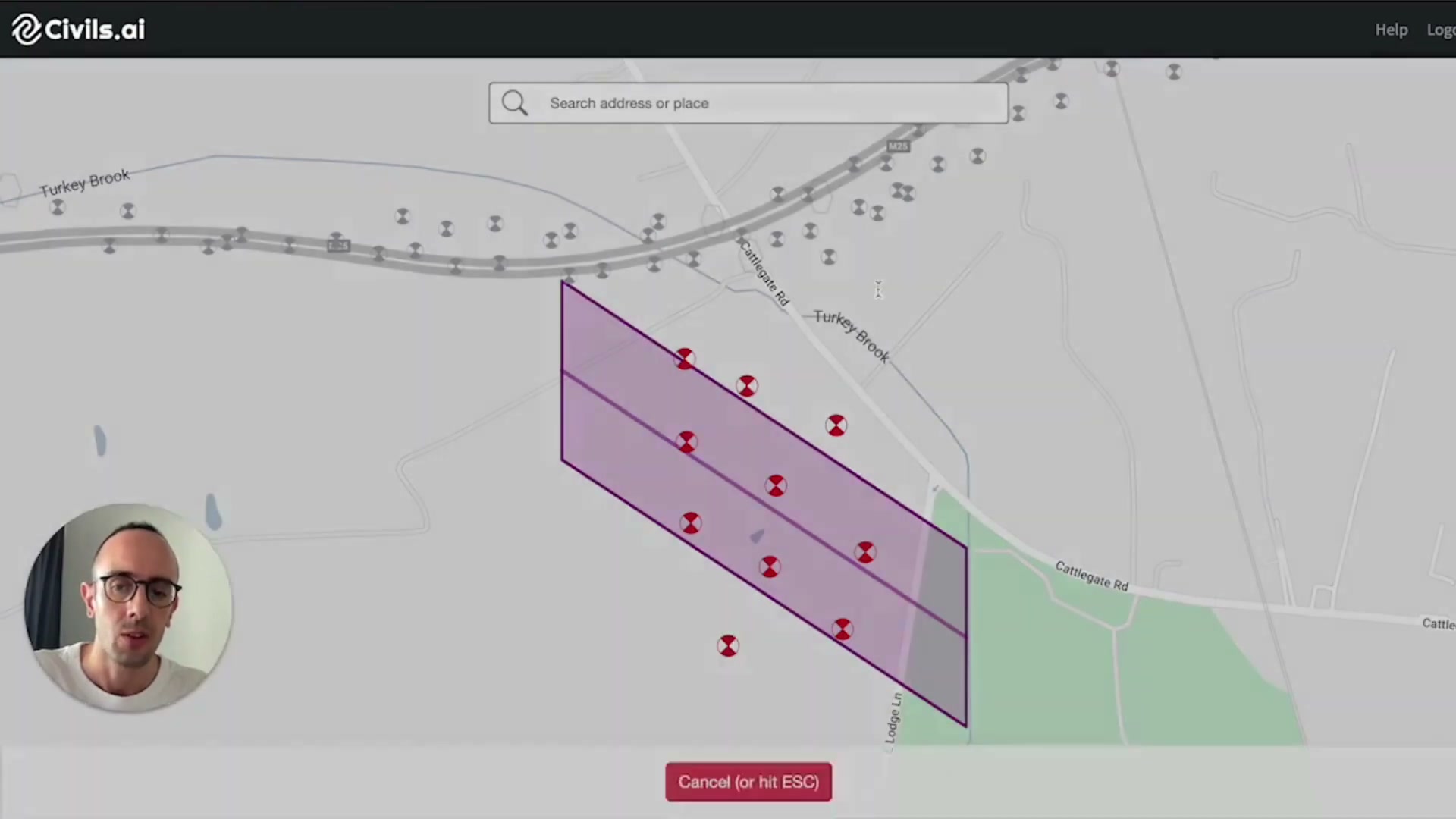
The specialised geotech surface, the clearest real-product UI in the set. A left rail offers “My geotech data,” “Borehole PDF digitiser” and “Request public data,” and (in the modelling view) “Cut 2D section” and “3D modelling.” The map plots digitised borehole locations (red markers) over a real site — here central London / Blackfriars — turning scanned site-investigation PDFs into a spatial subsurface model.
Inside a takeoff/demo — the document under analysis
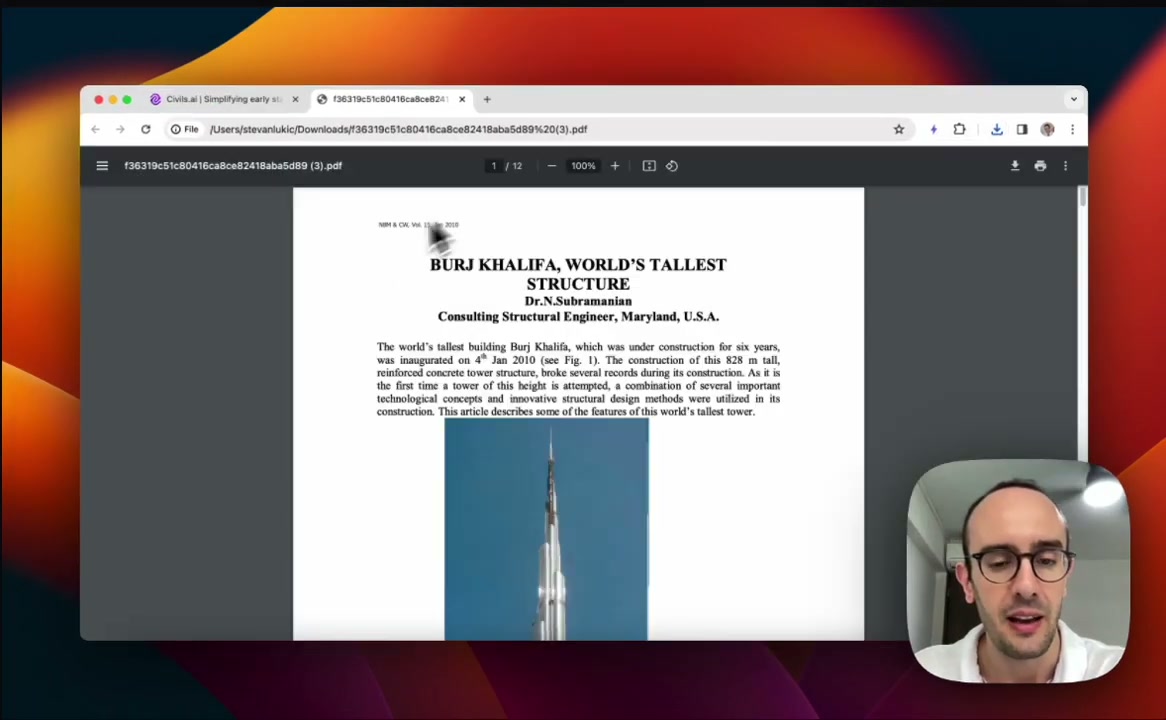
A frame from the product demo: a project PDF opened in the workspace, the raw material the takeoff and Q&A engines read. The demo is narrated by founder Stevan Lukic (visible in the corner) and shows the document-upload-and-analyse loop rather than a polished dashboard.
How they tell the story — the early-stage pitch
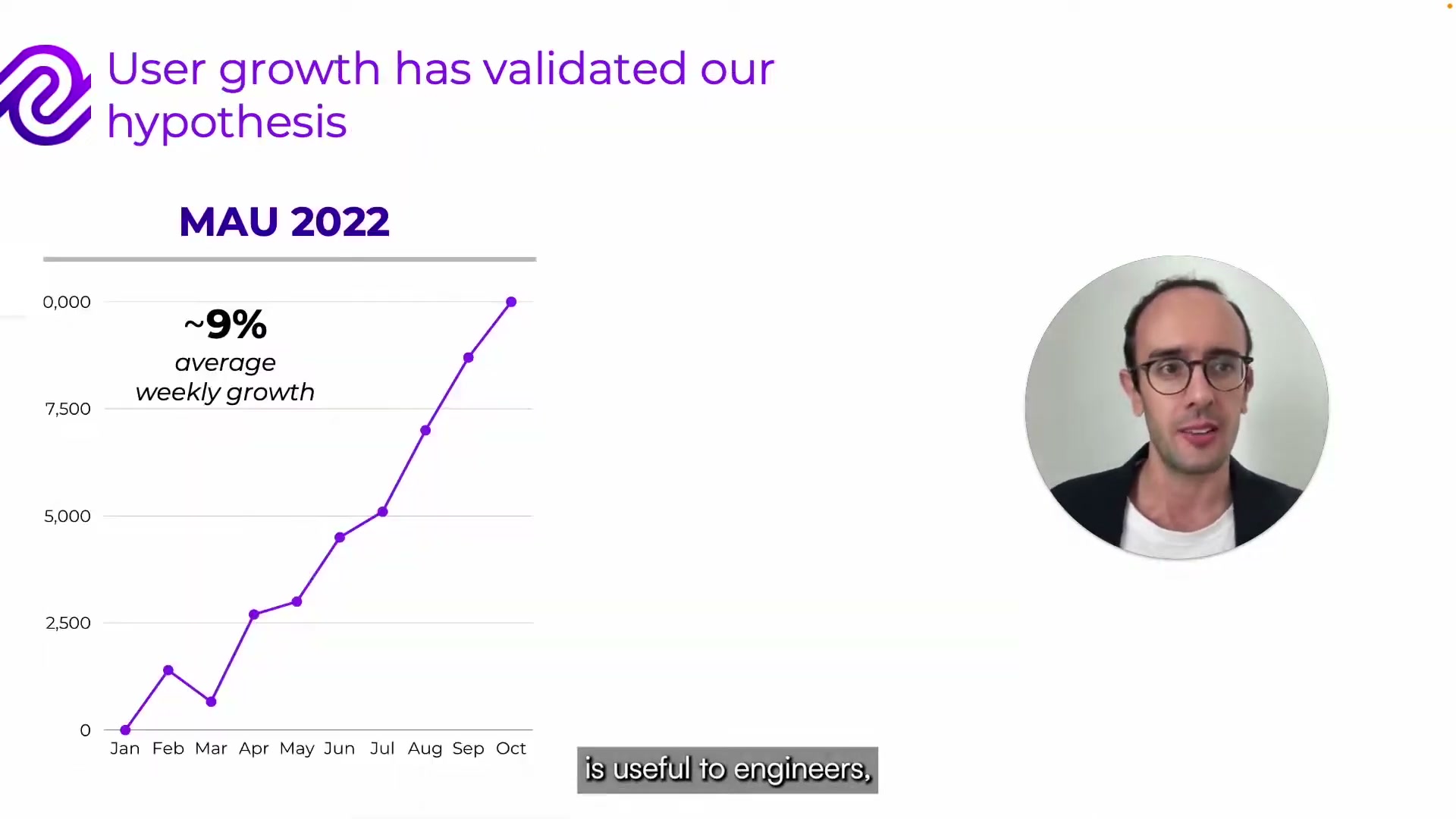
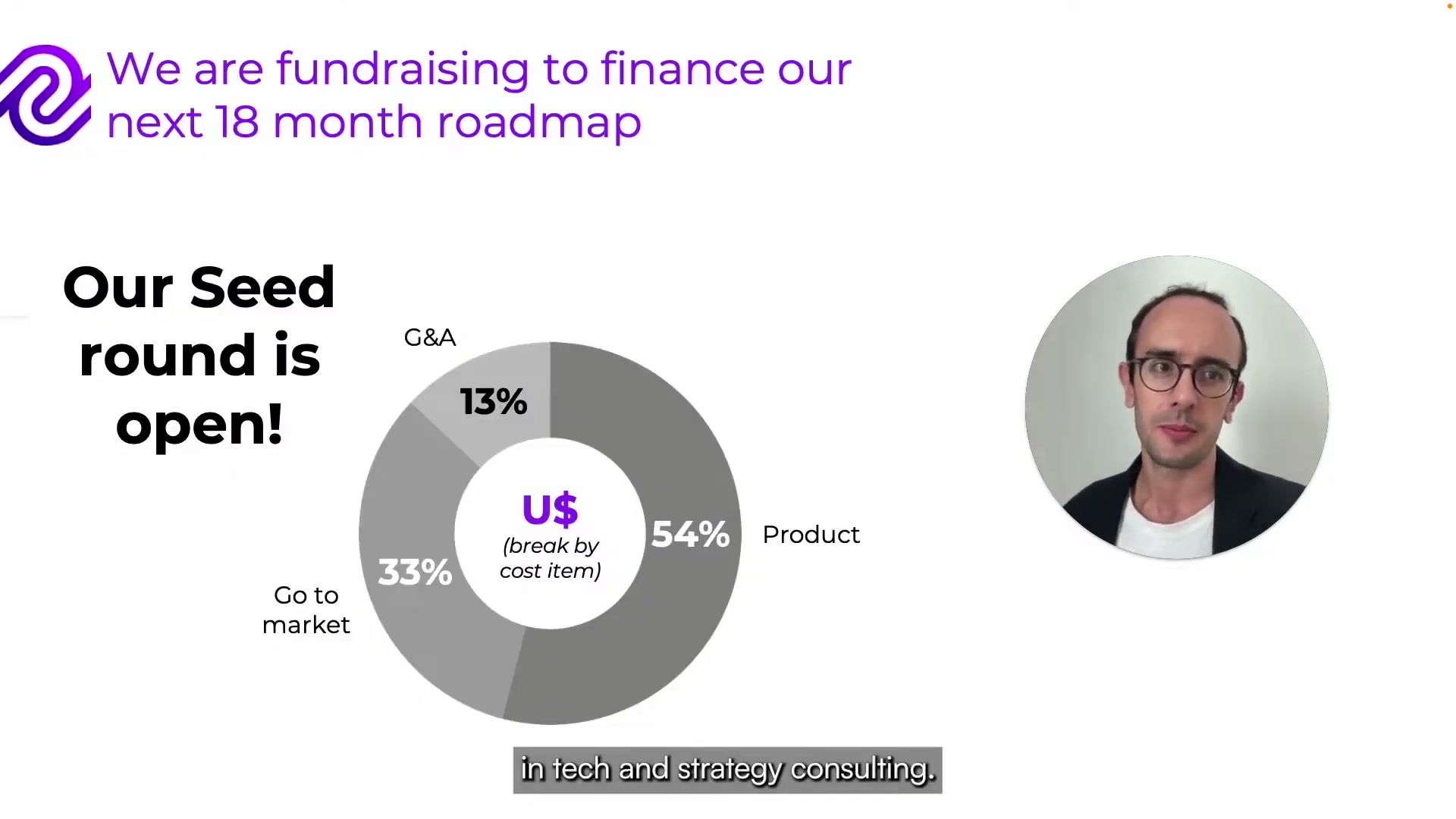
Two frames from the intro/pitch video that situate the company’s stage: a “User growth has validated our hypothesis” slide with a monthly-active-users chart (~9% average weekly growth, 2022), and the team slide — Stevan (CEO, “8 years as civil engineer”), Mirko (COO), with Arup, Morgan Sindall, Microsoft, Deloitte and academic marks beneath. These are investor-deck frames, not product, and they confirm the early-stage read.
Whole-set contact sheet
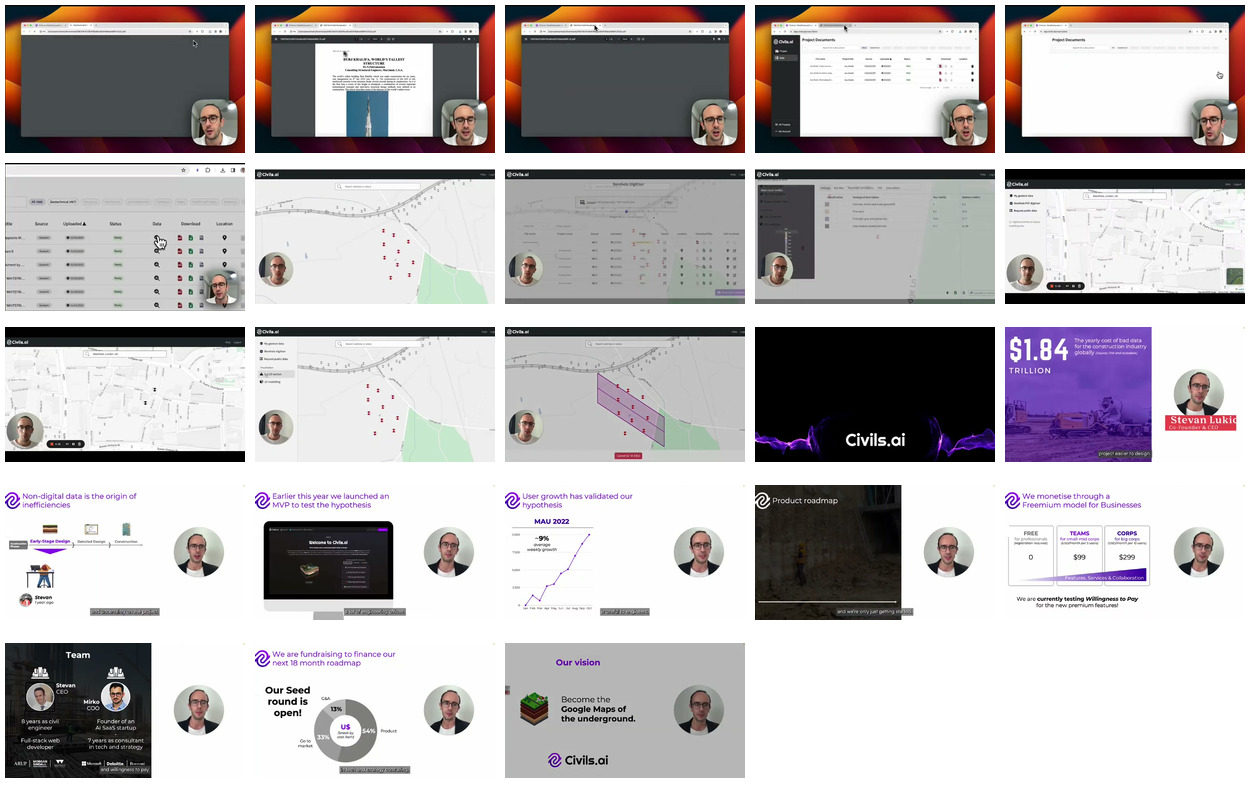
For a single-glance overview of every kept frame: contact_video.jpg.
Sources and method
- Product surface, the three pillars and how the AI works: vendor pages read directly — civils.ai home, /pricing, /ai-for-quantity-takeoffs-estimation, /ai-for-searching-construction-specifications (the specs & contract-checks page), and the geotech/earthworks pages. Captured in
raw/exa_search.jsonand the WebFetch reads. - Tender-review depth (the key question): the specs-and-contract-checks page (“identify key clauses, exclusions and obligations,” “extract submission dates… into a clear checklist,” “build a workflow once… then re-run it across tender packages,” NEC/JCT/FIDIC) plus the 2023 founder interview on the document-Q&A origin (risk summarisation, responsibility lookup, grounded-answer/anti-hallucination design).
raw/exa_search.json,raw/exa_answer.json. - The cost/benchmarking boundary: the pricing FAQ and multiple review profiles stating “no numerical reasoning/calculations” and “no unit rates, cost data, pricing or historical benchmarking” — the load-bearing absence for our thesis.
raw/exa_search.json,raw/exa_answer.json. - Pricing and metering: civils.ai/pricing (Starter $90 / Professional $270 / Enterprise custom; takeoff metering; API & MCP, SSO/SAML at Enterprise) corroborated by aggregator listings.
raw/exa_search.json. - Founding, stage and team: civils.ai/about (Stevan Lukic CEO ex-Arup/Morgan Sindall, Mirko Vairo COO, Mohamad Fadil CTO; Singapore HQ; founded 2022; pre-seed 2023 — Antler, Iterative, Atlas; ~15 staff) and the 2023 Construction Management interview.
raw/exa_answer.json,raw/exa_search.json. - Reception: no Capterra corpus and no G2 count retrievable; AI-tool aggregators (toolbit, usethisai, groupify, futurepedia, eliteai, findaitools) treated as directional given near-zero organic review volume — stated in the credibility caveat.
raw/exa_search.json,raw/exa_answer.json. - Mobile/app status: App Store search (US+GB) returned no genuine Civils.ai app (matched only unrelated AI chat apps) —
raw/youtube_search.jsonplus the discarded polluted App Store search;harvest_visuals.pyskipped (no real app),aggregate_dom.pyand the Capterra scrape skipped (no corpus). - Screenshots and gathering method (three walkthrough/pitch videos, scene-change frame extraction): screens/README.
- Method, limits, and the discipline of not asserting an absence without evidence: _RESEARCH-METHOD.